9-11-01
(From National Fire & Rescue Magazine, November, 2001)
“The eye of man hath not heard, the ear of man hath not seen, man's hand is not able to
taste, his tongue to conceive, nor his heart to report, what my dream was.”
-William Shakespeare
I am in a dream; I must be dreaming.
I know this because where I am standing, and what stands before me, cannot be real.
My sense of reality became questionable at nine o’clock this morning, with horrible images on a television screen that seemed impossible, that made no sense. Time slowed down, and began to bend. At 8 o’clock this evening reality became warped further with a telephone call, an anxious voice: “we need you there”. Suddenly I am traveling through the dark at speed down a deserted 8-lane highway; then a roadblock, flashing lightbars, flashlights in my face: “you may proceed”. More checkpoints, cops with worried looks, confusion: “move! move!” Now I am on foot, walking past a line of ambulances interspersed with TV satellite trucks. An attractive young female news correspondent in a short skirt, high heels and too much makeup stands with a microphone in her hand in the hard glare of a spotlight and watches me as I walk past. She has a frightened look on her face. In the real world, journalists aren’t supposed to be frightened; what world is this? I reach my destination, later to be known as Ground Zero, and I find out what world this is: it is the world of the unfathomable, and of the surreal, and nothing, nothing, will ever be the same again.
~~~~
In this new world, it is 11:00 p.m. on Tuesday, September 11th,
2001, and I am standing on the corner of West Drive and Vesey Street in lower
Manhattan. Three hours ago I was safe, sitting on my living room couch; now I
am standing ankle-deep in mud, wearing a respirator, surrounded on all sides by
complete destruction. I find myself rooted to this spot, staring, not knowing
how or where to proceed, what to do, or even what to think; it’s all happening
too fast, too different, too much.
“Slow Down, Michael,” I tell myself, remember my training: stop, take some time, look around, think, formulate a plan. I remind myself that I am here because I was asked to be here by the New York State Office of Fire Prevention and Control, at the request of State Fire Administrator Jim Burns, to use my skills as a photographer to document the scene and rescue efforts as I see them. As I see them…then that is what I must do. I must observe as much as I can, in my own way, and photograph it if at all possible, so that others someday might have a glimpse of what it was like to be here.
I decide that the best thing to do would be to follow the traditional approach of any emergency scene, and do a “size-up” by walking the perimeter of the site. Looking west towards the Hudson River, I see that the buildings continue from West Drive all the way to the water, so a full circuit of the perimeter is impossible. Forced to go in only one direction, I head east on Barclay Street.
I am barely
a quarter of the way down the block when I slowly come to a halt again, again
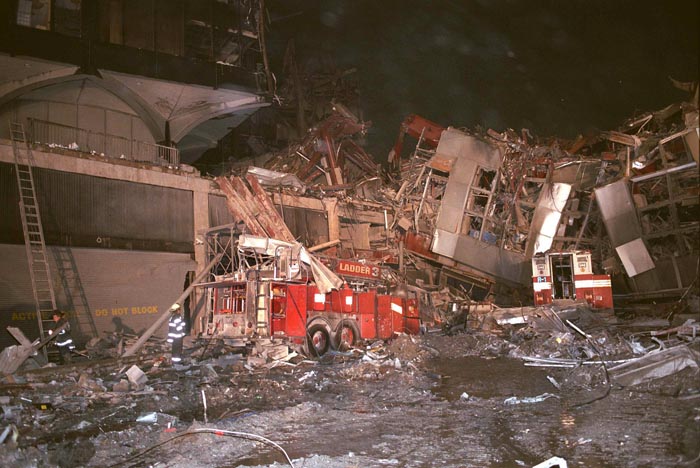
in awe. To my right rises a ten-story-high pile of debris, what used to be #7
World Trade Center. I remember from the newscasts that this was the third
building to fall, at roughly 5:00 p.m. this evening, after being engulfed in
fire after the two towers collapsed. 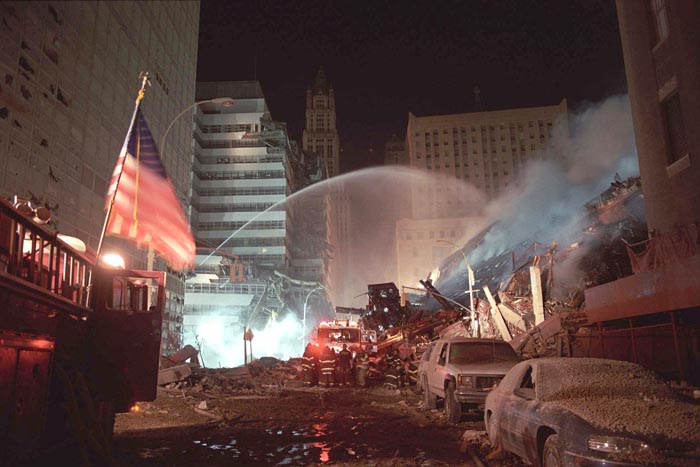 It is still burning in there somewhere;
thick clouds of smoke billow from inside the rubble as two FDNY tower ladders
use hose streams in an effort that I know will take hours, if not days, to
extinguish.
It is still burning in there somewhere;
thick clouds of smoke billow from inside the rubble as two FDNY tower ladders
use hose streams in an effort that I know will take hours, if not days, to
extinguish.
It is not the building that causes me to stop, however. What freezes me is the scene around it. More than any newscast of a brightly lit scene of rubble with hundreds of rescuers scrambling over it in search of survivors, or generators or heavy equipment or emergency vehicles racing to and from the scene, what I see before me tells me the true story of the World Trade Center Disaster.
On this side street, away from the commotion of the Command Post, rescuers move silently through a two-inch-deep layer of dust. It coats all of the vehicles parked on the street, as if after a snowfall on a winter’s eve. Coated too are the sides of all of the buildings surrounding me, save for hundreds of jagged black holes where windows were blown in from the force of the explosion. There is no more “street” and “sidewalk”; there now exists only a field of twisted pieces of sheet metal, paper, plastic and steel, spread around me as far as I can see. Scene lights and red rotating beacons atop the apparatus provide the only light, illuminating the dust that still blows through the air into an eerie, supernatural landscape. It is quiet here; no one is saying much. A firefighter passes by me. We look at each other, but there is nothing we can say, or even that needs to be said.
I pick my way slowly over to something that has caught my eye, about halfway down the block. It is a piece of steel girder, perhaps 25 feet long and 3 feet thick. It is hard to realize that it is a girder at first because it stands as tall as I am, and it has been bent into the shape of a pretzel.
My God.
Determined to move on, but unable to continue down Barclay Street due to the wreckage, I turn north onto Greenwich Street. There, covered with layers of dust and paper and lit by the harsh glow of scene lights, sit several NYPD patrol cars, belonging to the 17th Precinct just down the street. A makeshift “camp” has been set up in the shadows on the sidewalk in front of them: some office chairs, a small table and a couch that have been dragged onto the sidewalk from a gaping hole in the side of the office building there. Several weary-looking firefighters are sitting or lying down there, listening to a small beat-up looking radio that is tuned in to a local news station. I find it strangely macabre that we should be sitting a block away from devastation, listening for news about it. A firefighter offers me a small folding cot that is there: “come lie down if you’re tired”. Part of me wants very much to sit and be with them; to talk with them, to try to understand; another part of me is afraid to: as much as I am a fireman, I am not a New York City Fireman, and I am both honored and awed to be in their presence after what they and their own have seen and experienced and lost. I thank him, politely decline, and move on.
From Greenwich Street I turn east again onto Park Place, then south onto West Broadway, skirting the wreckage of building #7. I make the right onto Church Street, and begin walking south back towards the World Trade Center proper.
I reach the
intersection of Church and Dey Street, and look southwest, where the South
Tower used to be. Before me is the remains of #4 World Trade Center. The right
half of the building still stands, its façade shredded and blackened, but the
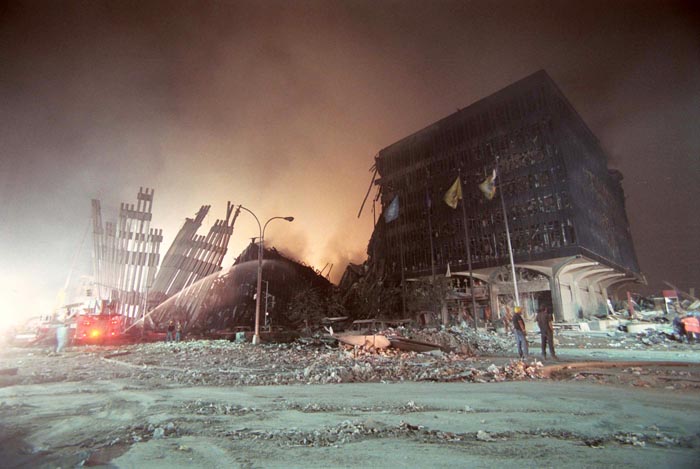 left half has been destroyed by the pieces of the south tower, which now tilt
up to the sky at crazy angles. Lit from behind, and seen through a mist of
smoke, ash and dust, it is a silhouette of destruction. On three flagpoles in
front, scorched and tattered flags still move in the soft breeze.
left half has been destroyed by the pieces of the south tower, which now tilt
up to the sky at crazy angles. Lit from behind, and seen through a mist of
smoke, ash and dust, it is a silhouette of destruction. On three flagpoles in
front, scorched and tattered flags still move in the soft breeze.
A young man and woman, both wearing surgical masks, approach out of the darkness carrying a milk crate filled with water, juice and sandwiches. I can see they are simply self-appointed volunteers, normal everyday caring citizens who took it upon themselves to load up a crate with food and drink and come to the scene to help the rescuers in any way they could. I take a bologna sandwich and a bottle of water. “Thank you, thank you so much for what you’re doing” they say to me. I am uncomfortable accepting the refreshments, but am even more uncomfortable accepting their praise. “No, no, thank you” I say, but they have moved on.
 I move on
as well, through small streams of hose line runoff and mud, until I come to a
more brightly lit area, at the corner of Church and Liberty Streets. There is
more activity here: a large crane has been set up, and a crew of 20 or so
ironworkers have set themselves to work on a large pile of girders, using
cutting torches to cut them into lengths that the crane can manage. It is agonizingly
slow, dangerous work; each girder is at least 100 feet long, and it takes
several minutes make even just one cut through a section. As I watch someone
yells out, and I turn to see that I have been narrowly missed by the crane hook
as it swings past…time to move on.
I move on
as well, through small streams of hose line runoff and mud, until I come to a
more brightly lit area, at the corner of Church and Liberty Streets. There is
more activity here: a large crane has been set up, and a crew of 20 or so
ironworkers have set themselves to work on a large pile of girders, using
cutting torches to cut them into lengths that the crane can manage. It is agonizingly
slow, dangerous work; each girder is at least 100 feet long, and it takes
several minutes make even just one cut through a section. As I watch someone
yells out, and I turn to see that I have been narrowly missed by the crane hook
as it swings past…time to move on.
I turn west
onto Liberty Street - aptly named, under these circumstances, I think to
myself - and make my way down to where some apparatus are operating. FDNY Tower
Ladder 124 is extended out over the wreckage, and a group of firefighters have
formed a human chain underneath it, passing ladders, tools and equipment
bucket-brigade style back out to the truck. 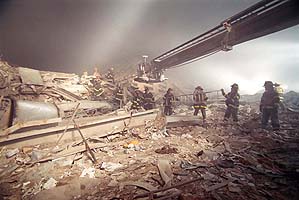 Beyond the extended tower rises a
small mound of debris and steel, then nothing but blackness. I am told that the
blackness beyond the rise is “the pit”, the stories-deep hole left in the plaza
area when the towers collapsed, and that this crew was just returning from a
search-and-recovery foray into the pit. Judging by the looks on the faces of
the firefighters, I conclude that it has not been very successful.
Beyond the extended tower rises a
small mound of debris and steel, then nothing but blackness. I am told that the
blackness beyond the rise is “the pit”, the stories-deep hole left in the plaza
area when the towers collapsed, and that this crew was just returning from a
search-and-recovery foray into the pit. Judging by the looks on the faces of
the firefighters, I conclude that it has not been very successful.
I continue west down Liberty Street, back into the darkness and quiet. As I reach Washington Street I come to what I think is a dead-end, a huge pile of girders and sheet metal blocking the street. As I pause to consider my options, a flashlight suddenly appears from the other side of the pile, flickering through the dust. A few moments later an EMS worker in full hospital scrubs comes towards me, clambering over an opening in the pile. I watch carefully where he goes, then as he leaves I retrace his steps through the small passage.
It is not without trepidation that I do this. The pile is about 20 feet high, made up of steel I-beams, bent pieces of rebar, sheet metal and countless smaller pieces of debris, all piled at crazy angles and all of it covered with a thick layer of dust and ash. It is pitch dark – I have only the light of my flashlight to see my way – and the footing is both tenuous and treacherous due to the combination of ash and dust on slippery sheet metal surfaces. Because nothing is level, each step is a search for the next solid, usable place to put your other foot, and I am hesitant to grab a hold of anything to use for stability, lest I upset some delicate balance that makes up this multi-ton pile of steel pick-up-stix. Doing a balancing act of my own, I successfully make it through to the other side, only to find myself standing shin-deep in a puddle of mud and water, caused by a steady rain of wind-blown spray coming from somewhere above me. Looking west down Cedar Street I see a silhouette of a FDNY Engine operating, and the entire street is awash in a fine spray of water. Looking up, I see three hose streams shooting from the fourteenth floor of one building into the next, and I am reminded that fires are still burning, and that there is a reason they’re fighting the fire from the adjacent building and not from within: this is not over yet, it is still too early; nothing is safe, or even certain.
Deterred by the falling spray – and for the sake of my camera equipment – I continue on Washington past Cedar Street to Albany Street, and then turn right to make my way west on Albany, back to West Drive.
~~~~
It is now about 2:00 a.m. on the morning of the 12th,
and I have made my way roughly three-quarters of the way around the perimeter
of the collapse. I am back on West Drive, looking north. Above me, in a
building of questionable stability, flames shoot out a window on the fourteenth
floor; a firefighter calls from the window of the adjacent building for more
pressure. In front of me, FDNY Ladder 113 sits abandoned and stripped of all
its tools, the front half of the rig nothing but a scorched shell. The south
walkway, an enclosed bridge that ran between the World Trade Center and the
World Financial Center, still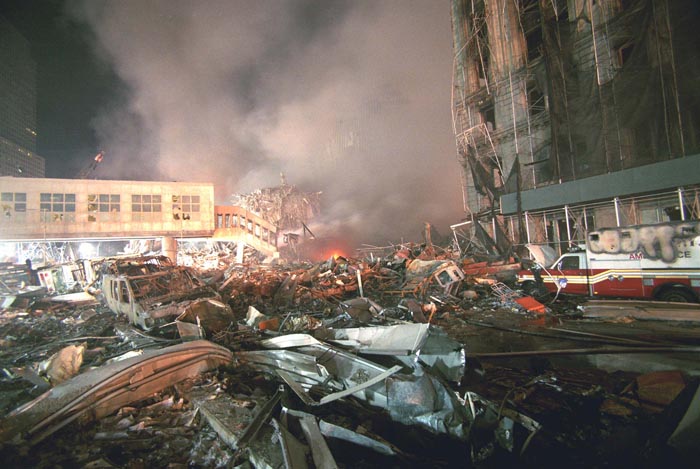 stands, but the stairway at the end now leads to
a twisted metal-strewn field of debris from which small spot fires still
flicker in the dark. Columns of smoke still rise in the distance. It takes an
hour for me to work my way slowly down the median strip of West Drive, past
burned-out cars and crushed ambulances, to a point where I can try to cross
over the northbound lane, but here West Drive has become a lake three feet
deep, so I am forced to retrace my steps back to the Albany Street intersection
and continue up the southbound lane. The passage is easier here, and I make my
way north, towards the true Ground Zero.
stands, but the stairway at the end now leads to
a twisted metal-strewn field of debris from which small spot fires still
flicker in the dark. Columns of smoke still rise in the distance. It takes an
hour for me to work my way slowly down the median strip of West Drive, past
burned-out cars and crushed ambulances, to a point where I can try to cross
over the northbound lane, but here West Drive has become a lake three feet
deep, so I am forced to retrace my steps back to the Albany Street intersection
and continue up the southbound lane. The passage is easier here, and I make my
way north, towards the true Ground Zero.
I reach the northwest corner of West Drive and Liberty Street, and for the first time I realize that I am becoming a little cold and very tired. I have been up for almost 20 hours, and the initial adrenaline rush is starting to wear off. A portable generator with a built-in scene light has been erected on the corner, and finding nowhere else better to sit, I set myself down on the trailer-hook portion of the generator, remove my camera belt and helmet, sit back and try to gather my thoughts for a moment.
A full two hours later, and I am still sitting there.
Thoughts? How can I possibly gather my thoughts? They come all in a rush, incomplete, mere pieces of thought, flailing within my head, each trying to find it way into some sort of pattern that makes some sense of what I am seeing and have seen. In a brief moment of clarity I realize that it is the scale of what is before me that is immeasurable; it goes on and on and on and on and yet as I look down I see at my feet a piece of paper, a portion of a ledger book, burned around the edges, with a hand-written note on it. This paper was a small part of someone’s world, they held this in their hands…they were real, they existed, had families, friends and lovers…had feelings. I reach down and slowly run my fingers through the layer of dust and ash at my feet. I rub it between my fingers; it has a soft, powdery texture, almost like talcum powder. I let some of the dust fall from my hand, and it blows away in the soft breeze. Why is it that I cannot feel anything right now?
Some time later I am joined by some FDNY firefighters who
have been assigned here to operate Engine 210, which is parked amid a sea of
mud and papers a short distance away from me. The entire rig is covered in
dust, but appears otherwise unscathed. I have not seen anyone go near it the
entire time I have been here until now. “Their entire company is missing” one
of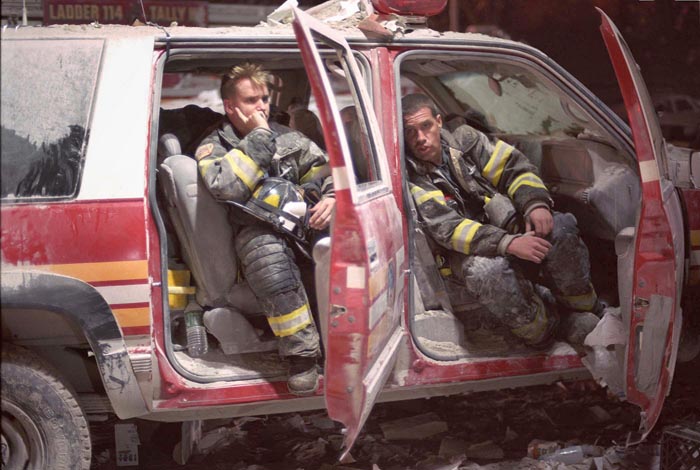 the firefighters tells me quietly. As their Lieutenant goes off to get
further orders, they sit in the remains of a wrecked Battalion Chief’s Suburban
to wait. We sit together for a time, not speaking. We don’t need to.
the firefighters tells me quietly. As their Lieutenant goes off to get
further orders, they sit in the remains of a wrecked Battalion Chief’s Suburban
to wait. We sit together for a time, not speaking. We don’t need to.
~~~~
Time again to move on. I wish the men well, and walk north on West Drive, underneath the south walkway, across World Financial Center Drive, to the World Financial Center building. Here again the sidewalk is blocked by large piles of debris, so in order to continue north I enter the ground floor of the building, into what used to be a health club.
It is an eerie sight. The force of the collapsing towers has blown out all the windows, and the heat from the blast has melted all of the aerobic equipment inside into strange, gruesome shapes. I climb out of one of the window openings onto a large girder, and see that have reached the edge of the main debris field.
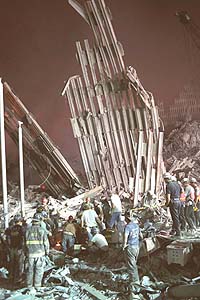 There is
activity here. In the harsh glare of scene lights, at the base of a 50-foot
tall chunk of World Trade Center exoskeleton, a group of 20 or so rescuers has
found a body. Several FDNY firefighters, along with some steelworkers and a
group of volunteer firefighters from Long Island, are trying to recover it from
beneath a large steel girder. I watch them for a period of time, during which
they try everything from digging underneath it to an all-out tug-of-war with a
human chain of firefighters using ropes lashed to the girder. There is an air
of frustration; the beam is so large and so buried that even after several
attempts at “1…2…3…HEAVE!!” it hasn’t moved even an inch.
There is
activity here. In the harsh glare of scene lights, at the base of a 50-foot
tall chunk of World Trade Center exoskeleton, a group of 20 or so rescuers has
found a body. Several FDNY firefighters, along with some steelworkers and a
group of volunteer firefighters from Long Island, are trying to recover it from
beneath a large steel girder. I watch them for a period of time, during which
they try everything from digging underneath it to an all-out tug-of-war with a
human chain of firefighters using ropes lashed to the girder. There is an air
of frustration; the beam is so large and so buried that even after several
attempts at “1…2…3…HEAVE!!” it hasn’t moved even an inch.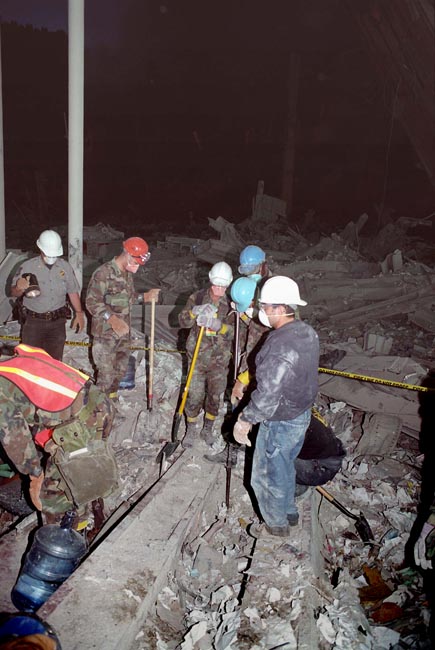
A rescue foreman climbs over to where they are working.
“Look, guys, this isn’t working. We gotta move on.”
“No, wait! We can get her out! We almost have her!”
“Guys, I know how much you want this, but this is taking too much time. We gotta keep looking…the dogs may have found something over by the south tower.”
“No, wait, please – we can do this!”
“I’m sorry guys…we can get her as soon as we can get a crane in….”
The team lingers, and then reluctantly moves away. Those of us remaining stand in silence, left to our own thoughts, rooted by the sight of a single slender female arm emerging from underneath that huge piece of steel.
~~~~
 Dawn, at Ground Zero.
The sky begins to grow brighter to the east, and a tableau
of destruction slowly appears before me. Amid billowing clouds of smoke, huge
100-foot pieces of the towers jut out of the ground at crazy angles where they
were imbedded after smashing down with forces that I cannot even begin to
comprehend. In my delirium, after being up all night, I feel like I have
traveled back through time, to Dresden, Germany, after the bombing. No, I
realize, it is more like the movie “The Day After”. This is the Day
After. I must document it. Weary from lack of sleep, I begin to make my way
back around the perimeter, back the way I came.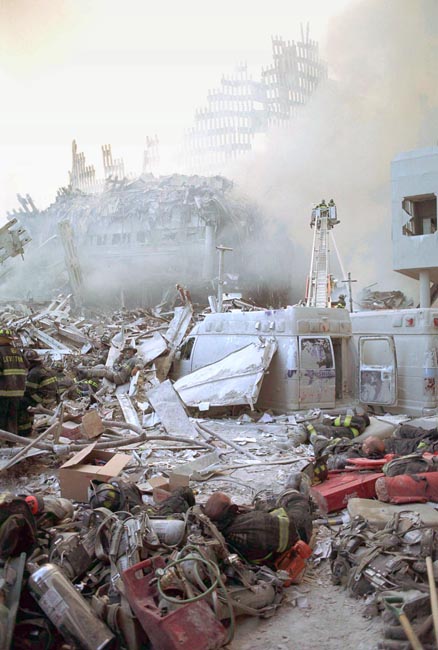
I trudge south, back along West Drive, past overturned vehicles and firefighters sleeping as best they can amid piles of equipment and debris, past 210 Engine, to an area just beyond where National Guard troops have located what looks to be a part of another body. I watch as they use some bits of found debris to very gently and carefully brush away surrounding dust and papers, while another Guard member lays out a body bag next to it. In the background, smoke rises from something that is burning in the rubble.
I casually decide I don’t need to see any more, and turn away before they finish. For some reason, the whole scene just doesn’t register. I suddenly realize to my dismay, but without surprise, that I have probably gone numb, or into some degree of shock.
Gotta keep moving.
Back up Albany Street, to Washington, then onto Liberty Street again. 124 Truck is still there, but for the moment there is no work going on. Firefighters sit and wait, but there is little talk.
I turn
north onto Church Street, and here it has become very busy. With the light of
day has come a renewed rescue and recovery effort, and between the two
buildings of #4 and #5 World Trade Center several hundred people are working to
remove debris. 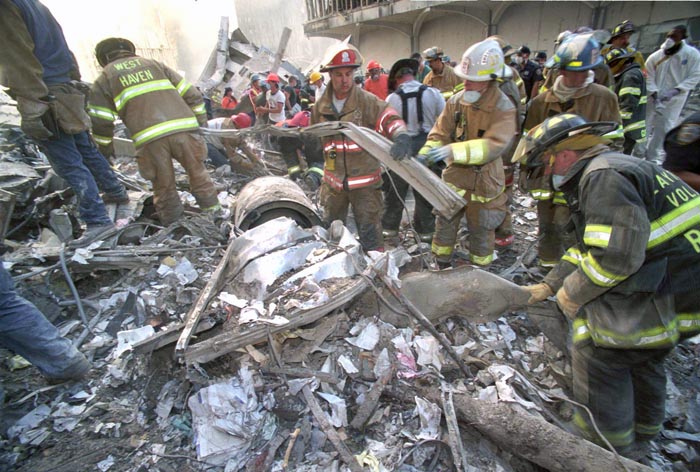 Walking among them, I see that they represent every possible
embodiment of public safety-related profession that you could conceive of:
FDNY, Volunteer Firefighters from all over, NYC EMS, NYPD, Transit Police, FBI,
DEC, Housing Authority Police, ATF, NYC Public Works, DOT, Ironworkers, plus
numerous others…all working together, side by side, as one. I am impressed to
the point to where I put down my camera gear and pitch in, helping to lift
here, pulling a piece of scrap metal out of the way there…we move quickly; but
carefully, pausing only when we encounter a piece of steel too large for us to
move. A K-12 saw is brought in, and sparks fly.
Walking among them, I see that they represent every possible
embodiment of public safety-related profession that you could conceive of:
FDNY, Volunteer Firefighters from all over, NYC EMS, NYPD, Transit Police, FBI,
DEC, Housing Authority Police, ATF, NYC Public Works, DOT, Ironworkers, plus
numerous others…all working together, side by side, as one. I am impressed to
the point to where I put down my camera gear and pitch in, helping to lift
here, pulling a piece of scrap metal out of the way there…we move quickly; but
carefully, pausing only when we encounter a piece of steel too large for us to
move. A K-12 saw is brought in, and sparks fly. 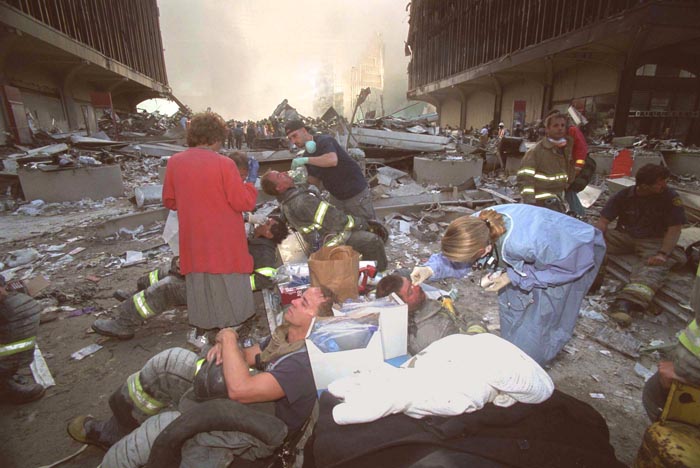
There is not much more I can do
here for a while, so I pick up my gear and begin to move on. As I leave, I see
that a makeshift “infirmary” has been set up by local hospital workers and Red
Cross volunteers near to where everyone is working. As I pass by, I am grabbed
by the arm by a woman in surgical scrubs. “Let me see your eyes!” she says, as
she turns me so that she can look directly into them, her face inches from
mine. After a moment I seem to pass the test and am allowed to continue, but
not before noticing several other rescue workers seated nearby who did not
pass, and were forced to have their eyes irrigated with saline solution –
whether they wanted to or not.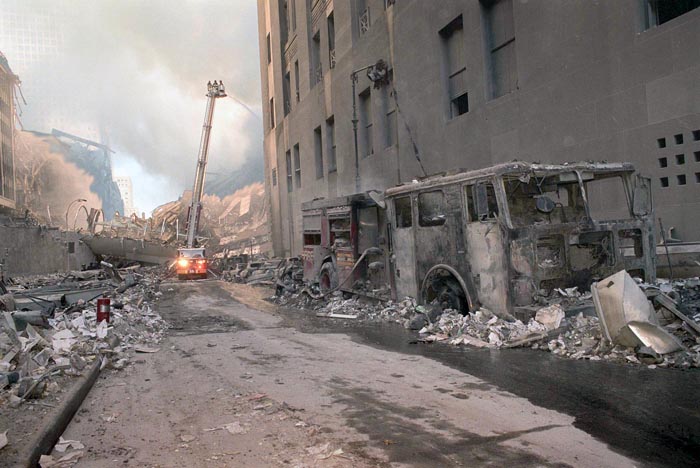
More destruction. On Church Street, Ladder 9 sits in ruins, its windows smashed, covered in dust and chunks of concrete. On Vesey Street, between the shell of #5 World Trade Center and the Post Office building, an unknown FDNY engine rests on the pavement, its wheels melted, the truck body burned beyond the point of recognition. A 1-3/4” line is still attached to one of the discharges.
At the intersection of Greenwich and Barclay Streets, the heavy equipment has begun to move in. A tower ladder is still operating there, directing a master stream onto the enormous smoldering pile of #7 World Trade Center. The street still needs to be cleared however, so piece by piece a pay loader begins the process of loading up a nearby dump truck. Down a side street, 50 more dump trucks are waiting to take its place. I know that before they are done, they will need 50 times again more.
~~~~
Exhausted. Legs hurt. Numb. I have been carrying a full load of bunker gear, cameras and lenses for 16 hours now, and the objective, overseeing side of me realizes with dismay that I have become tired to the point where as muscles gave out and reaction times slowed, I would be in danger if I were to continue here much longer. Juggling feelings of both disappointment and relief, I begin the long walk back to my car.
After a few blocks I reach a police barricade, pressed up against which are dozens of journalists, TV crews and curious onlookers with cameras. I had forgotten all about the fact that my turnout gear was caked with dust and mud, and that I had been allowed into an area where relatively few people were permitted. Suddenly, to my surprise, I am the focus of a swarm of TV cameras, still cameras, and reporters with notepads and endless questions: “What is it like in there? What did you see? Have they found anyone alive? Did you see any bodies? What was your name again?”
I do the best I can. I remember to be polite; as a journalist myself I appreciate how nice it is when someone you are interviewing takes the time to answer questions and be polite. After awhile a National Guard Hummer comes down the street towards us with a guardsman manning a machine gun on the roof. This causes quite a stir with the journalists and they all run off to investigate, leaving me alone again with my thoughts.
I realized how uncomfortable I felt about being interviewed. Not because I was uncomfortable being in front of cameras or talking to the media, but because I felt like I was not a good representative of those who were doing the real work in there: those firefighters who were spending desperate hours digging in the pit for their brother firefighters and their fellow man, hoping against hope to find someone still alive. In this strange, horrible, surreal world that I have just come from, their love for one another was the only think that kept shining on, the only thing to me that was truly real.
But then, my sense of reality has been changed, inexorably and forever. I drive up West Drive, away from the scene, and I pass throngs of New Yorkers holding up signs: “Thank You Firefighters - You Are Our Heroes!!”
I am a Firefighter, but am I a Hero? No, I am not a hero – I am only a Man, merely a human being, just trying to help. We are all only human, but it is our humanity that makes us special.
What a chimera, then, is man! what a novelty, what a monster, what a chaos, what a subject of contradiction, what a prodigy! A judge of all things, feeble worm of the earth, depositary of the truth, cloaca of uncertainty and error, the glory and the shame of the universe!
- Blaise Pascal
I drive onward, towards home.




