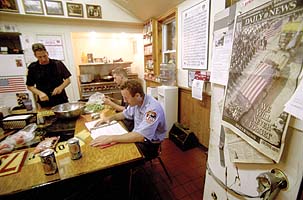
 In the upper opposite corner of the room the TV is showing a silent
Yankees game, base hits accentuated by banging pots and pans as we start
setting the table.
In the upper opposite corner of the room the TV is showing a silent
Yankees game, base hits accentuated by banging pots and pans as we start
setting the table.(From National Fire & Rescue Magazine, October, 2002)
It is a midsummer’s eve, the kind you remember from when you
were a kid: a 100+ degree day now cooling as dusk falls, the air still humid,
but now with a light breeze. A thunderstorm may pass; some light raindrops
fall. At the quarters of New York City Fire Department Ladder 79/Battion 22 on
Castleton Avenue in Staten Island, it is dinnertime and the 6x9 shift is in the
kitchen preparing the meal, coating chicken breasts and chopping carrots as the
new Red Hot Chili Peppers CD rocks from the stereo in the corner next to the
microwave. In the upper opposite corner of the room the TV is showing a silent
Yankees game, base hits accentuated by banging pots and pans as we start
setting the table.
It is as it should be, in every story about life in any firehouse that you have ever heard or read. The scene repeats itself over and over, in thousands of firehouses across the country, every single day.
But there are numerous small details that give away the fact that this is now a little bit different, and not how it always was: a child’s scribbled crayon drawing of the Twin Towers and a fire truck with the words “Thank You Fire Man” is taped to the cupboard, and on the wall next to the sink is a framed embroidery with the words, “Heroes Lie In Our Hearts Forever”. The boom box blasting the Chili Peppers was a gift from The Bose Corporation, who donated one to each firehouse in the entire city, and there, on the wall next to the window, is a framed poster of the 343 firefighters who lost their lives on 9/11/01.
~~~~
Everyone knows about September 11th, 2001; there
is not much more that can be said about that day or the period following it
that hasn’t been re-examined and re-told over and over again. 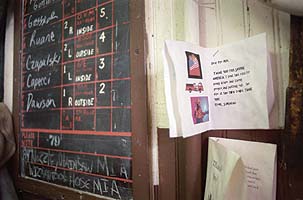 We all know about
the incredible outpouring of caring, support and concern for the FDNY and its
members that has come as a result of that day from both the public and
firefighting communities, and how it continues on even to this day. During a
recent trip to the small town of Shelby, North Carolina, I was approached on
several occasions by both civilians and fellow firefighters: “How are they
doing? Are they OK? Can we do anything else to help? Tell them that we’re
praying for them and that we’re there for them if they need us.” This, a full
ten months later, demonstrated to me the depth of caring that the rest of the
country feels for the members of the FDNY…and how it is not likely to go away
anytime soon.
We all know about
the incredible outpouring of caring, support and concern for the FDNY and its
members that has come as a result of that day from both the public and
firefighting communities, and how it continues on even to this day. During a
recent trip to the small town of Shelby, North Carolina, I was approached on
several occasions by both civilians and fellow firefighters: “How are they
doing? Are they OK? Can we do anything else to help? Tell them that we’re
praying for them and that we’re there for them if they need us.” This, a full
ten months later, demonstrated to me the depth of caring that the rest of the
country feels for the members of the FDNY…and how it is not likely to go away
anytime soon.
For the firefighters, though, all the attention has been a little bit of a double-edged sword. Ever since September 11th they have been living their lives in the public eye, as if under a microscope, and while this has done wonders for morale and public support when it comes to union issues, etc., there is a growing sense among the membership of “thank you so much, we are so grateful for your thoughts, gifts and prayers, but come on now, enough already…we need to get on with our lives!” This sentiment was even illustrated in a recent New York Times article entitled “You’re Too Kind, Firefighters Say, Truly Meaning It” that asked people to please stop sending in gifts – they have no more storage space in which to put them.
But the question, “How are they doing?” is legitimate. It is our human nature to care about our fellow man, especially after such a tragedy. The answer to that simple question, however, is fairly complex.
The part that is the least difficult to describe is that having to do with the effects of 9/11 on the FDNY’s Operations structure. All of the apparatus and equipment that was lost or damaged has since been either repaired or replaced, and companies are now taking deliveries of new apparatus on a schedule similar to that used before the tragedy.
One
particular area of Operations that was most affected, though, was that of manpower:
the loss of 343 seasoned firefighters and officers notwithstanding, the events
of September 11th caused a wave of retirement activity, as many older members
chose to leave the job sooner than they might have normally.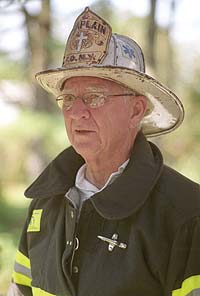 The reasons behind
this are many and varied: some were due to retire anyway; for some family
pressure played a part; for others the events of September 11th were
just too much to deal with, and it was “time”. To meet this loss of manpower,
and make up for anticipated future retirements, two classes of new probationary
firefighters – over 600 - have since graduated and joined the department, with
plans to add a significant number more – up to 1500 over the next couple of
years - as older members become eligible for retirement and move on. This
influx of a large number of new firefighters, along with a significant number
of promotions in rank within the department – many more than normal – has
solved problems with day-to-day operations but in turn has also created a
situation where a substantial number of the workforce is or will be new to the
job, with little fireground experience. “A man may join a company,” says FDNY
Chaplain Emeritus Al Thompson, “and the next senior man may only have three
years on the job. That’s not much experience. The Captains, and others who may
be more experienced, are concerned: you get the “big one” – I don’t mean a
fifth alarm or even an all-borough alarm, but even just an “all-hands” fire or
a second alarm – there’s concern about the inexperience of most of the men…it
just creates a lot more tension for the officers, and a lot more tension for
those few senior men who are left.” Battalion Chief Tom Giordano was Captain of
Ladder Company 101 the day the towers were attacked. “The job is going to be
different, and we’re going to have to be more careful, “ he says. “The job has
always been aggressive – that’s the firefighter’s job, to be aggressive – but
because of the young guys now, we’re going to have to be a little slower, and
whichever senior guys we have left on the job now have to teach as much as they
can to the junior guys. Whatever knowledge they have, they have to give it all
to these young guys.
The reasons behind
this are many and varied: some were due to retire anyway; for some family
pressure played a part; for others the events of September 11th were
just too much to deal with, and it was “time”. To meet this loss of manpower,
and make up for anticipated future retirements, two classes of new probationary
firefighters – over 600 - have since graduated and joined the department, with
plans to add a significant number more – up to 1500 over the next couple of
years - as older members become eligible for retirement and move on. This
influx of a large number of new firefighters, along with a significant number
of promotions in rank within the department – many more than normal – has
solved problems with day-to-day operations but in turn has also created a
situation where a substantial number of the workforce is or will be new to the
job, with little fireground experience. “A man may join a company,” says FDNY
Chaplain Emeritus Al Thompson, “and the next senior man may only have three
years on the job. That’s not much experience. The Captains, and others who may
be more experienced, are concerned: you get the “big one” – I don’t mean a
fifth alarm or even an all-borough alarm, but even just an “all-hands” fire or
a second alarm – there’s concern about the inexperience of most of the men…it
just creates a lot more tension for the officers, and a lot more tension for
those few senior men who are left.” Battalion Chief Tom Giordano was Captain of
Ladder Company 101 the day the towers were attacked. “The job is going to be
different, and we’re going to have to be more careful, “ he says. “The job has
always been aggressive – that’s the firefighter’s job, to be aggressive – but
because of the young guys now, we’re going to have to be a little slower, and
whichever senior guys we have left on the job now have to teach as much as they
can to the junior guys. Whatever knowledge they have, they have to give it all
to these young guys.
Concern
about the safety of newer members is only one of the pressures facing the
officers these days – especially those officers who have been newly-promoted.
One concern has to do with the concept of having to “fill in the shoes” of
those officers – from Lieutenant all the way up to Chief Of Department – who
were killed on September 11th. In many cases promotions were granted
“early” simply to fill positions vacated by the disaster, so that the new
officers might not have had the amount of time on the job at their previous
rank that others before them might have had before being promoted, creating
self-doubt in some cases: “Am I ready for this?” And, there is the “legend”
phenomenon to deal with: if the deceased officer was well-liked or highly
respected by his company while he was alive, the pressure on his replacement –
from both the company and from his own
demons – can be overwhelming, to the point where at least one newly-appointed
officer requested transfer out of a company because he felt he couldn’t live up
to the image of the former officer that was lost. In truth, it is the
psychological issues that far outweigh the logistical issues in terms of the
FDNY’s continued recovery from the World Trade Center Disaster.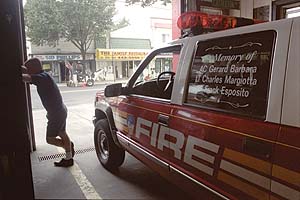
But to try to describe how the FDNY is doing as a whole in terms of its emotional well-being, however, is not so easy. There are over 10,000 members of the FDNY, and one must not forget that each member is an individual unto his or her own, made up of all the childhoods, past experiences, lifestyles, habits, hopes, dreams and personality foibles that makes each of us unique in our own way. While it can be said that every member of the department probably suffered as a result of September 11th, it could also be said that no two members were affected by it in the same way: individual firefighters’ experiences range from surviving the collapse inside one of the towers to being away on vacation and missing the event entirely. While it’s likely that every member knew someone who died, some may only have known one or two casually, while others lost dozens of close personal friends that day. Consequently, it’s difficult to draw any conclusions that might speak for the entire membership as a whole.
What can be definitely stated as fact is the fire department’s efforts to rise to the emotional needs of the membership after the disaster. Shortly after the attack, through a combined effort from FEMA and the FDNY’s Counseling Unit, Crisis Intervention Teams were sent to each of the firehouses that lost members. Each team was made up of a Crisis Intervention Counselor, a member of the clergy, and a “peer”; someone that the firefighters could hopefully relate to more easily: a retired firefighter, for example. The plan at that point was to try to deal with any immediate psychological needs the members of the company might have, and to possibly stem the natural inclination for one to stuff down one’s feelings regarding the event, by getting the firefighters to verbalize and talk about how they felt about what had happened.
The
attempt, while well-intentioned, was only partially successful. For some
firefighters, having the teams there helped them greatly. FDNY Battalion Chief
Tom Giordano was Captain of Ladder Company 101, and lost seven members of his
company. 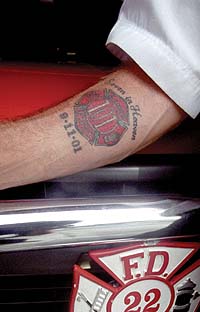 “There were always people coming,” he says, “and we would sit down in
the back room, maybe 15 or 20 guys, with a couple of counselors, just talking,
and that was big…that’s big for the fire department, especially the companies
that were hit hard.” But for many firefighters it was just too soon to
try to deal with what they had witnessed, and after the second visit to the
firehouses some teams were told, in effect, “please just leave us alone – we’re
not ready!”
“There were always people coming,” he says, “and we would sit down in
the back room, maybe 15 or 20 guys, with a couple of counselors, just talking,
and that was big…that’s big for the fire department, especially the companies
that were hit hard.” But for many firefighters it was just too soon to
try to deal with what they had witnessed, and after the second visit to the
firehouses some teams were told, in effect, “please just leave us alone – we’re
not ready!”
And – there was still work to do. The day-to-day job of protecting the city from fire still had to be done. For many, the simple process of responding to alarms was a source of comfort in its familiarity, and helped many firefighters cope by providing a sense of the “normal” and the routine in a world where much seemed to be suddenly very strange and unreal. There was also the fact that the members of the department were and would be involved in the recovery effort at Ground Zero for months to come; in this sense the tragedy for the firefighters did not end on September 11th but instead continued on, as a 24 hours-a-day, in-your-face reminder of their losses as they worked to recover their brothers from the wreckage. (“The recovery was a horror,” says firefighter Bill Whelan of Engine 216, “…we were down there day after day, looking and searching, and not finding anything….”) There were funerals and memorials to attend, arrangements to be made…these things, along with the sustained months-long “adrenaline rush” of the entire incident, worked to keep the membership busy and distracted from really having to deal with their own individual personal feelings about the event. On May 30th, however, the last piece of steel was brought out from Ground Zero, and with it came the official end of the recovery project. But for the members of the New York City Fire Department, another kind of work would be continuing on for a long time to come: that of healing themselves. And, that work is only now just beginning.
~~~~
It is another sunny July afternoon in the Williamsburg section of Brooklyn, and at the quarters of Engine 216/Ladder 108 it’s mealtime again as heaping plates of pasta are passed around. The ever-present silent ballgame is on the TV as Housewatch calls the meal over the firehouse p.a. system: “Chow’s on! Chow’s on!” As we take our places around the table amid scraping chairs and clattering silverware, we are joined by two unfamiliar faces: a young girl in her 30’s and an older, middle-aged gentleman who are both dressed in civilian clothes. I lean that they are both counselors, assigned to spend two days a week at 216/108 as part of Project Liberty, a FEMA-sponsored project that is working to help make counseling services available to the firefighters if they should need them. Their role at the firehouse is somewhat passive: aside from a short daily discussion of different topics relating to psychology and mental health, their job is to just “hang out” at the firehouse and make themselves available should someone wish to talk.
A while later, as the Truck returns from a stuck elevator run, we gather in the kitchen for today’s topic, “Depression: recognizing the symptoms”. Despite the best efforts of the counselors, the discussion is mostly one-sided, and as many of the firefighters sit mute, I can see that the counselors will have a long way to go before they gain the trust of the men that is so badly needed before they can really begin to help.
I have no trouble understanding this. As firefighters, it is part of our nature to want to place the needs of others ahead of our own. So too is the fact that – being mostly made up of males - we all carry a sense of “machismo” to varying degrees: “I can handle it! I don’t need anyone’s help!” Then add to that the strong bond that exists between the members of each particular firehouse – made even stronger after September 11th – and you can see the formidable task that would be trying to get the firefighters to open up and talk about their true feelings…with strangers, no less.
So how are
they dealing with it these days, if not with the counselors? Again, different
reactions from different people. I posed the question to Vincent “Vinnie”
Tummino, who is a firefighter currently assigned to the 22nd
Battalion in Staten Island. A 32-year veteran of the job, he is also President
of a fraternal organization within the FDNY, the Columbia Association. 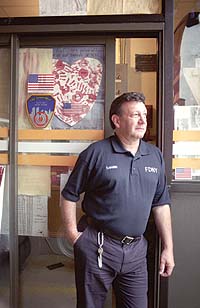 “From
what I see, every person I talk to…I can’t pinpoint any particular person who I
would say to myself, ‘whoa, that person should go to counseling’ or ‘that guy
just is not going to make it.’ I haven’t found one, and I talk to so many
people – in the firehouse here, in the Battalion, and throughout the job.
Overall I think the guys are coming along…they may be hiding some of their
feelings, but I think they’re learning to cope with it, where they’re out of
the danger zone of having a nervous breakdown or something to that effect. I think
for all intents and purposes everyone seems to be OK. I think it brought a lot
of firemen closer to their own families. In today’s day and age, where everyone
gets divorced, it seems like this might be another process of where guys may be
closer to their wives and their children than they ever were before, which is
another form of healing where you have love and affection from other people.”
“From
what I see, every person I talk to…I can’t pinpoint any particular person who I
would say to myself, ‘whoa, that person should go to counseling’ or ‘that guy
just is not going to make it.’ I haven’t found one, and I talk to so many
people – in the firehouse here, in the Battalion, and throughout the job.
Overall I think the guys are coming along…they may be hiding some of their
feelings, but I think they’re learning to cope with it, where they’re out of
the danger zone of having a nervous breakdown or something to that effect. I think
for all intents and purposes everyone seems to be OK. I think it brought a lot
of firemen closer to their own families. In today’s day and age, where everyone
gets divorced, it seems like this might be another process of where guys may be
closer to their wives and their children than they ever were before, which is
another form of healing where you have love and affection from other people.”
I then asked him how he was personally coping with the tragedy. “I probably knew at least 50 [that died] personally. In my organization there were 47 names that were removed from our rolls, that were killed that day. Personally, one of my best friends was killed that day…I had a lot of friends, but he was a ‘best friend’. It’s hard…I just think it’s a little easier when you’re older to accept certain kinds of death, or death itself. As you get older and your parents die, a sister or brother may pass away, an aunt, an uncle or cousins…and you’re more apt to accept that that’s how life is: as you get older, unfortunately more people die, but then you wind up with grandkids on the other side of the coin. So I think it’s easier for an older person to handle the situation than the kids in the firehouse who are 30 years old, and their first dog has not died yet…it’s got to be a traumatic experience for them. Personally, I think my greatest healing process was that I was very fortunate, being President of the Columbia Association. I’ve probably gone to 50 places around the country, and it gave me the opportunity to tell a story – like I am now – and I think the more times I’m telling it, the easier it is for me to talk about it. That’s part of my healing process…you have to talk it, and not hold it in. It’s going to take a long time; I don’t think the healing will ever be over…there will always be a stain in your brain of it.”
Chief Giordano had a similar response to the same
question: “My personal feeling is that definitely don’t think there’s a
timetable for the healing process – especially the firehouses that were hit
hard.” He paused for a moment. “I think we’re definitely on the road to
recovery. 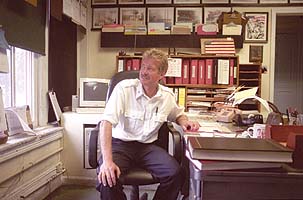 If you sit in the firehouse, you always talk about it; every time I
come to work you can never go a day without somebody talking about it. But when
that bell rings, and it’s time to go out, the guys always do their job…I never
have any question about the guys doing their job, because that’s what
firefighters do – they will do their job. But when you come back to the
firehouse, that’s when you start thinking again, and remembering…and that’s
when it gets hard again. But the recovery? I don’t think the experts know how
long the full recovery is.” I asked about his own struggle. “Me myself? I don’t
think I’m dealing with it too well…I still wonder sometimes if I should be
taking time off because…because it just doesn’t feel right. But then when I
come to work, I feel OK, because the firehouse atmosphere is something that…you
can’t describe how it is. When you say the word ‘support’…just talking amongst
ourselves in the kitchen, just sitting around the table…that was big for me,
the first few months after the whole incident…that was like my therapy. I’ve
still been dealing with my old company – I see them all the time, talk to them
all the time, and everybody’s still having a tough time. You just kind of find
your own way to deal with things. Your own family I think helps…it makes you
concentrate on keeping things good at home. But I talk to a lot of people and a
lot of people are having trouble at home, dealing with their wives…me myself, I
can’t friggin’ remember anything (he chuckles)…my mind is shot – it’s
unbelievable.”
If you sit in the firehouse, you always talk about it; every time I
come to work you can never go a day without somebody talking about it. But when
that bell rings, and it’s time to go out, the guys always do their job…I never
have any question about the guys doing their job, because that’s what
firefighters do – they will do their job. But when you come back to the
firehouse, that’s when you start thinking again, and remembering…and that’s
when it gets hard again. But the recovery? I don’t think the experts know how
long the full recovery is.” I asked about his own struggle. “Me myself? I don’t
think I’m dealing with it too well…I still wonder sometimes if I should be
taking time off because…because it just doesn’t feel right. But then when I
come to work, I feel OK, because the firehouse atmosphere is something that…you
can’t describe how it is. When you say the word ‘support’…just talking amongst
ourselves in the kitchen, just sitting around the table…that was big for me,
the first few months after the whole incident…that was like my therapy. I’ve
still been dealing with my old company – I see them all the time, talk to them
all the time, and everybody’s still having a tough time. You just kind of find
your own way to deal with things. Your own family I think helps…it makes you
concentrate on keeping things good at home. But I talk to a lot of people and a
lot of people are having trouble at home, dealing with their wives…me myself, I
can’t friggin’ remember anything (he chuckles)…my mind is shot – it’s
unbelievable.”
Back at the firehouse, a short while after lunch, I
stood on the apparatus floor with Bill Whelan of Engine 216, who will be
retiring in a few weeks from the FDNY after 32 years with on the job. He is
also President of a fraternal organization, the Emerald Society. I asked him
his opinion on how the FDNY was recovering. “[The recovery effort] gave us
something to do,” he said. 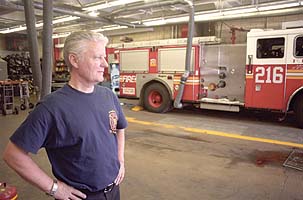 “Then we had all of the funerals, and memorials…we
were doing something, we weren’t just sitting around, we were out, active. But
now that most of those have passed, we’re starting to feel…I don’t know if it’s
depression or not, or just the downtime after it. A lot of the guys handle it
different ways, firehouses handle it different ways. Some of the firehouses are
very good, some are not so good. Young guys are trying to feel their way along,
and the older guys are trying to help them get there, and…it’s been tough, and
it’s going to be tough. I’d say it’s going to be another three or four years
before we start to heal properly. [But] Now is when it’s going to start hitting
guys. If they’re in the firehouse, and it’s not a busy firehouse…you’re there,
and you have time alone, and time to think…some of the families are putting
pressure on the guys – especially anyone who is close to getting out, the
families want them out. They say, “enough already! We don’t want to have to
worry about you every time you walk out the front door…we don’t know if you’re
ever coming back.” So there’s a lot of pressure on them from that aspect, and
then the pressure of sadness, the depression of losing your buddies, your
friends, your brothers, fathers, sons…it’s a long road. But, we have a lot of
good young guys coming in, good guys that want the job, and they’re coming in
with a good attitude.” He also refers to how the close-knit friendships within
the firehouse can act as a healing agent of its own: “We watch out for one
another…a guy that comes in, if he’s grumpy today, and it’s been two days in a
row for a guy that’s usually a happy-go-lucky guy, we sort of get him aside and
talk to him, see how he’s feeling, tell him what’s available to him, you
know…we’re all there for him if he needs something, he gets it…so we take care
of one another. We have a long way to go, we do definitely need counseling, it
has to be there for us and some guys have to avail themselves of it, but being
firemen the ‘macho’ thing prevents a lot…I get calls from wives now, especially
when I go to meetings or events, and the wife will come up to me and say “my
husband’s not handling this very well”. Now I see him and I think he’s
doing very well, but when he goes home that’s a different ballgame. She’ll say
‘what can we do? What can I do?’ and I’ll say ‘well, everything’s there for
him.’ She’ll say ‘but you know firemen, they won’t ask for help, they won’t
avail [themselves] of it.’ So I’ll say, ‘you have to ask for help for you,
and the kids, and then make him go with you. That way you get him there…’cause
he’s not going to do it on his own.’ They don’t do that, unfortunately…they’ll
find a different route, and it’s usually not a better one.”
“Then we had all of the funerals, and memorials…we
were doing something, we weren’t just sitting around, we were out, active. But
now that most of those have passed, we’re starting to feel…I don’t know if it’s
depression or not, or just the downtime after it. A lot of the guys handle it
different ways, firehouses handle it different ways. Some of the firehouses are
very good, some are not so good. Young guys are trying to feel their way along,
and the older guys are trying to help them get there, and…it’s been tough, and
it’s going to be tough. I’d say it’s going to be another three or four years
before we start to heal properly. [But] Now is when it’s going to start hitting
guys. If they’re in the firehouse, and it’s not a busy firehouse…you’re there,
and you have time alone, and time to think…some of the families are putting
pressure on the guys – especially anyone who is close to getting out, the
families want them out. They say, “enough already! We don’t want to have to
worry about you every time you walk out the front door…we don’t know if you’re
ever coming back.” So there’s a lot of pressure on them from that aspect, and
then the pressure of sadness, the depression of losing your buddies, your
friends, your brothers, fathers, sons…it’s a long road. But, we have a lot of
good young guys coming in, good guys that want the job, and they’re coming in
with a good attitude.” He also refers to how the close-knit friendships within
the firehouse can act as a healing agent of its own: “We watch out for one
another…a guy that comes in, if he’s grumpy today, and it’s been two days in a
row for a guy that’s usually a happy-go-lucky guy, we sort of get him aside and
talk to him, see how he’s feeling, tell him what’s available to him, you
know…we’re all there for him if he needs something, he gets it…so we take care
of one another. We have a long way to go, we do definitely need counseling, it
has to be there for us and some guys have to avail themselves of it, but being
firemen the ‘macho’ thing prevents a lot…I get calls from wives now, especially
when I go to meetings or events, and the wife will come up to me and say “my
husband’s not handling this very well”. Now I see him and I think he’s
doing very well, but when he goes home that’s a different ballgame. She’ll say
‘what can we do? What can I do?’ and I’ll say ‘well, everything’s there for
him.’ She’ll say ‘but you know firemen, they won’t ask for help, they won’t
avail [themselves] of it.’ So I’ll say, ‘you have to ask for help for you,
and the kids, and then make him go with you. That way you get him there…’cause
he’s not going to do it on his own.’ They don’t do that, unfortunately…they’ll
find a different route, and it’s usually not a better one.”
Some kids run by the front of the firehouse, laughing, jostling. Nearby on the “el”, a subway train rumbles by. I ask him if he had made any attempts to deal with his own feelings about that day.
He looked at something across the street, or far away. “No…no, I’m putting that off until I retire…and I know it’s going to hit me.”




