"...and they called it RODEO"
(From National Fire & Rescue Magazine, January, 2002)
Professional Bullrider Rob Bell of Alberta, Canada is having a bad week. Ranked 7th in the world, he was unable to stay on for his first two rides, and then last night he was disqualified for accidentally touching the bull with his “free” hand during his ride – a violation of the “free hand rule”. What makes it all worse is that he’s sore, nursing a bruised arm. He sits on a treatment table, his back to the wall, his eyes and thoughts focused on something far away.
~~~~
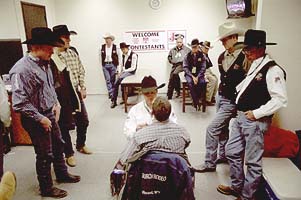
I am sitting in the Training Room of the University of Nevada Las Vegas’s Thomas and Mack Arena, surrounded by some of the finest rodeo cowboys in the world. They, in turn, are surrounded by some of the most skilled Athletic Trainers, Physicians and Therapists in the world: the members of the Justin Sportsmedicine Team. They have all come to participate in what could be termed the “Superbowl” of rodeos, the National Finals Rodeo. For the cowboys, it has taken a year of hard work to get here, but for the sport of rodeo, it has been over one hundred years.
Back in the 19th century, many of those living in the mostly uninhabited areas west of the Mississippi were ranchers, making their living working with horses and cattle. As part of their daily chores, they were required to break and brand horses and calves, and to rope the occasional stray that would wander away from the herd. It is not known when exactly the sport of rodeo was begun, but it is believed that it began in 1864, when two groups of cowboys from neighboring ranches in Deer Trail, Colorado met to settle a dispute over who was the best at performing everyday ranching tasks. Considered by many to be the first rodeo, these tasks evolved into the six main areas of competition at a rodeo: Steer Wrestling, Calf Roping and Team Roping, which are timed events, and Bareback Riding, Saddle Bronc Riding and Bullriding, which are judged events, wherein points are awarded to both the rider and the animal (assuming he can stay on for the required eight seconds!)
From those
humble beginnings, rodeo has evolved into a modern, professional sport. In
2000, cowboys competed for over $32 million in prize monies, with $4.4 million
alone up for grabs at the 2000 National Finals Rodeo. The Professional Rodeo
Cowboys Association, the largest and oldest rodeo-sanctioning body in the
world, has over 10,000 registered members, and sanctions close to 700 rodeos a
year across 39 states and 4 Canadian provinces. 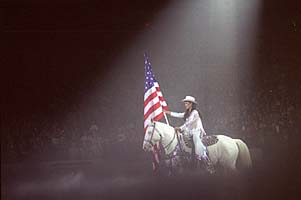 The National Finals Rodeo is
their premier event, comprised of 10 days of competition wherein the top 15 money-earning
cowboys in each event vie with each other to have the highest score or fastest
times over the 10 rounds to become the best in the world at what they do. Over
1,000 workers help to put on the event, along with the over 120 contestants and
hundreds of horses, calves and bulls that make up the best of the best
livestock raised by the country’s best Stock Contractors – breeders whose job
it is to raise the calves that run the fastest and the bulls that buck the
hardest. The event is always a sell-out every year, with over 170,000 in
attendance in 2000.
The National Finals Rodeo is
their premier event, comprised of 10 days of competition wherein the top 15 money-earning
cowboys in each event vie with each other to have the highest score or fastest
times over the 10 rounds to become the best in the world at what they do. Over
1,000 workers help to put on the event, along with the over 120 contestants and
hundreds of horses, calves and bulls that make up the best of the best
livestock raised by the country’s best Stock Contractors – breeders whose job
it is to raise the calves that run the fastest and the bulls that buck the
hardest. The event is always a sell-out every year, with over 170,000 in
attendance in 2000.
And boys
and girls, I can personally attest that this show is no sappy, cliché’
country-western honky-tonk! The production is nothing short of impressive: as I
stand at the edge of the arena at the beginning of the 5th night’s
competition, the lights suddenly go out, and the first notes of AC/DC’s “Hell’s
Bells” comes booming out of the PA system. The arena fills with fog, and as the
announcer introduces the show, we are treated to a laser light show that rivals
any rock ‘n’ roll stage production. Opening ceremonies follow, and then it’s on
to the real rock ‘n’ roll – rodeo at its wildest and most dangerous!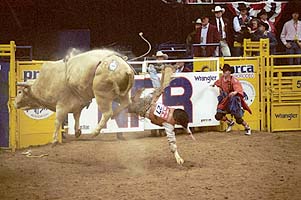
I can honestly say that unless you’ve witnessed a rodeo live and up-close, you have no true idea of how violent the sport really is. Watching it on TV just does not do it justice. Standing at the rail of the arena, I’m sometimes only a few feet from the livestock - close enough to feel chunks of dirt hitting me, kicked up by the horses’ hooves as they go by; close enough to smell the leather from the saddles and the sweat coming up off the animals; close enough to hear the grunts of the bulls, and the curses of the cowboys trying to stay on them. One forgets how large and massive these creatures are – between 1,200 and 2,000 lbs – and folks I’m here to say that they move fast and they move hard!
~~~~
The first event of the evening is the Bareback Riding competition, and it isn’t long before there is the first casualty: 13th-ranked cowboy Kelly Wardell of Bellevue, Idaho gets tossed like a salad off of Rafter G’s “Durango”, and as he hits the dirt one of the horse’s hooves lands on his right forearm. Luckily for Kelly it doesn’t break, but just as luckily the Justin Sportsmedicine Team is right there with him to quickly lead him off to the nearby Training Room for some treatment.
The Justin
Sportsmedicine Team, and the Sportsmedicine Program, play an invaluable role in
today’s modern rodeo. 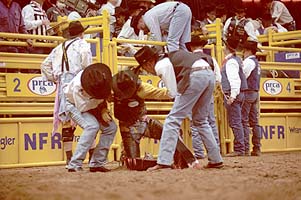 It goes without saying that in a sport as physical and
dangerous as this, injuries are a way of life. “It’s not a question if
you’ll get hurt” as any cowboy will tell you, “it’s a matter of when, and how
badly”. What’s not as obvious, though, is how critical the role of the Justin
Sportsmedicine Program is.
It goes without saying that in a sport as physical and
dangerous as this, injuries are a way of life. “It’s not a question if
you’ll get hurt” as any cowboy will tell you, “it’s a matter of when, and how
badly”. What’s not as obvious, though, is how critical the role of the Justin
Sportsmedicine Program is.
Today’s Professional Rodeo Cowboy makes his living by competing in rodeo events all across the country, and lives by award monies alone – if he does not do well at an event, he simply doesn’t get paid. The sport is still young and/or unnoticed enough that there are still no corporate sponsorships of individual riders (although hopefully that may change soon), so it’s every man for himself. Prior to the advent of the Justin Sportsmedicine Program, if a cowboy got hurt at an event, his day was done and he went home hungry…or worse yet, because he was hungry, he would try to compete through the pain, and injure himself further. Through first aid, physical therapy, education and training, the Justin Sportsmedicine Program allows cowboys to compete more often and more safely than ever before.
The Justin
Sportsmedicine Program (JSP) was founded in 1980 by J. Pat Evans, MD, an
orthopedic surgeon and Team Physician for the Dallas Cowboys, and Don Andrews,
who spent over 14 years as an athletic trainer for pro hockey teams. Recognizing
that there was a need for on-site medical support at professional rodeos, a
sports medicine system was created which combined on-site facilities with local
hospitals and clinics across the nation, along with a network of selected local
orthopedists, trauma specialists and athletic trainers, who in addition to a
core group of physicians that travel around the country, become part of the
team at each event. 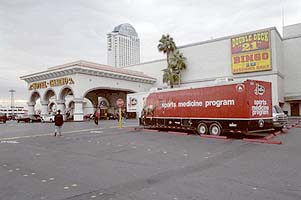 With this design, in any city that a rodeo is held where
the JSP is involved, not only will there be an on-site facility, but also a
local hospital or clinic standing-by with physicians who are specially trained
in the needs of the rodeo cowboy. In 1981 the Justin Boot Company, wishing to
promote their name as well as support both the cowboys who wore their products
and the innovative sportsmedicine idea, became the first and only sponsor of
the program, and to this day they provide a large part of the funding for the
program, which is provided free of charge to all of the contestants. Thus what
began small – treating 775 contestants at 10 PRCA rodeos in the first year,
from the back of a pickup truck – has grown into an integral part of the PRCA
rodeo circuit, treating over 6,000 a contestants a year at over 125 rodeos. The
Team now has two permanent facilities in Guthrie, Oklahoma, and Mesquite,
Texas, and the mobile unit employs a new 40-foot fully-equipped trailer that
travels from show to show. In addition, the JSP is tied in to the American
Sports Medicine Referral System, which links doctors and specialists from
around the country with rodeo athletes, so that they can receive care at any of
the rodeos they attend, even if the JSP is not there. “We have already
pre-established [in that town] local sports medicine specialists and
hospitals,” says JSP Executive Director Don Andrews. “We’ve got a system on
hand that will help the cowboy as long as he needs it for whatever he needs.
It’s kind of ‘one-stop shopping’ for the cowboy’s medical needs. Whatever
happens, they’ll have the best medical attention possible.”
With this design, in any city that a rodeo is held where
the JSP is involved, not only will there be an on-site facility, but also a
local hospital or clinic standing-by with physicians who are specially trained
in the needs of the rodeo cowboy. In 1981 the Justin Boot Company, wishing to
promote their name as well as support both the cowboys who wore their products
and the innovative sportsmedicine idea, became the first and only sponsor of
the program, and to this day they provide a large part of the funding for the
program, which is provided free of charge to all of the contestants. Thus what
began small – treating 775 contestants at 10 PRCA rodeos in the first year,
from the back of a pickup truck – has grown into an integral part of the PRCA
rodeo circuit, treating over 6,000 a contestants a year at over 125 rodeos. The
Team now has two permanent facilities in Guthrie, Oklahoma, and Mesquite,
Texas, and the mobile unit employs a new 40-foot fully-equipped trailer that
travels from show to show. In addition, the JSP is tied in to the American
Sports Medicine Referral System, which links doctors and specialists from
around the country with rodeo athletes, so that they can receive care at any of
the rodeos they attend, even if the JSP is not there. “We have already
pre-established [in that town] local sports medicine specialists and
hospitals,” says JSP Executive Director Don Andrews. “We’ve got a system on
hand that will help the cowboy as long as he needs it for whatever he needs.
It’s kind of ‘one-stop shopping’ for the cowboy’s medical needs. Whatever
happens, they’ll have the best medical attention possible.”
~~~~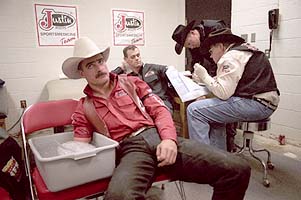
I follow Kelly Wardell back to the Training Room, and witness this special attention firsthand. A DC Pulsed Galvanic Electric Stimulator (or “stim unit”) is attached to his arm, and then his arm is immediately submerged in a bucket of ice water. “The idea is to stay ahead of the game,” I’m told by Rick Foster, a member of the Sportsmedicine Team. With most minor injuries such as this, the human body will have a tendency to “overreact” to the injury by quickly sending extra blood-flow to the area, causing bleeding and swelling in the area of the injury. This overreaction can actually slow down the healing process. By using the RICE acronym (Rest, Ice, Compression and Elevation) the trainers hope to short-stop the body’s overreaction, enabling Kelly’s arm to heal faster than it otherwise would have. The stim unit’s electrical current causes the small blood vessels in his arm to constrict, reducing the potential for swelling. Also, and for reasons that are not fully understood, it also helps to reduce the pain.
The rush to begin treatment is well-founded:
today is only the 5th “go-round” of a 10-day competition, and Kelly
is due to ride again tomorrow, and each day thereafter – if he can. There is a lot
at stake here: at the NFR, there are winners of each day’s rodeo, but there are
also winners of the combined totals at the end of the competition. 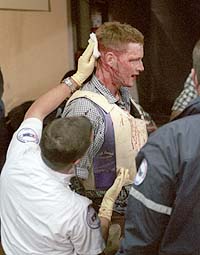 Each round
in each event has a combined purse of over $42,000, and which he may be out of
tonight’s round, he still wants a part of tomorrow night’s prize money.
Football players, by comparison, have it easy – if they get injured during a
game, they have a whole week to recover!
Each round
in each event has a combined purse of over $42,000, and which he may be out of
tonight’s round, he still wants a part of tomorrow night’s prize money.
Football players, by comparison, have it easy – if they get injured during a
game, they have a whole week to recover!
The range and type of injuries typically sustained by Rodeo Cowboys is broad. A comprehensive 20-year study of rodeo injuries completed in 2000 provided some interesting statistics: of the over 1,300 rodeos attended by the JSP and the close to 7,000 performances held during the 20-year period, close to 8,800 athletes (13.98%) of 62,000 evaluated were treated for minor injuries, while close to 900 (10.17%) were treated for major injuries that required a trip to the hospital. Of those injuries, injuries to the head and face were most common, followed by knee, shoulder and spine injuries. The most dangerous events? Bullriding (you knew it!), causing over 50% of the injuries, followed by Bareback Riding and Saddle Bronc Riding.
The JSP admits that there is somewhat of a dilemma about how to improve safety within the sport. These days just about every cowboy in the bucking events wears a Kevlar-lined vest to prevent injury to the back and chest should he get kicked while he’s down, but head protection is another matter. You will see some cowboys wearing field hockey-type helmets in the bucking events, but JSP founder Dr. Evans feels they could be as detrimental as they are helpful: the rider’s visibility is limited, and the added weight could promote neck injury as his head is whipped back and forth as he rides. As for protection from being stepped on or kicked? “They did a physics study once,” he tells me, “where they calculated the amount of force a 1,800-lb bull would exert over a 6” diameter circle (the size of his hoof) as it falls from a distance of a few feet…”
I didn’t need to do the math!
~~~~
Two hours
to go until go-round #6. The Thomas and Mack Training Room is filled to
capacity, with cowboys and trainers preparing for tonight’s show. Massages are
given, ice packs are administered, and contestants are taped-up for their
upcoming rides. Bullrider Rob Bell is there, finishing his treatment. As he
walks past me on his way to the locker room to get ready for tonight’s ride, I
wish him better luck this time around. “Well…it can’t get any worse” he
mumbles.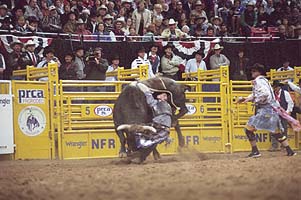
He’s wrong. It gets worse, a lot worse. For tonight’s round Rob has drawn a ride on Growney Bros. “Real Deal”, and shortly after leaving the bucking chute Real Deal busts a move and sends Rob flying towards mother earth…only his right hand stays caught in the rope! The ½-ton of pissed-off beef starts whipping around in a circle, and for several horrifying seconds Bell stays attached, tossed and flailed about like the proverbial rag-doll. Finally, he slips free, and collapses to the ground, unconscious.
The reaction is instantaneous. Bullfighter Darrell Diefenbach, working his first NFR, rushes in and puts himself between Bell and the bull, distracting him away from the cowboy to prevent him further harm. At the same time, Justin Sportsmedicine Team members who were stationed next to a gate at ringside rush to his side.
The stadium goes completely quiet – you could hear a pin drop. Bell lies motionless, and we all fear the worst. Suddenly, though, he stirs, and as he groggily gets up and the Justin Team helps him away, the crowd roars their approval. He will be back to ride another day – the Justin Sportsmedicine Team will make sure of it.




