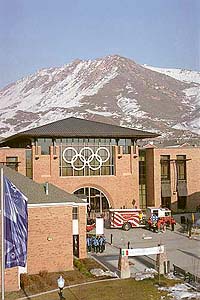
with the Salt Lake City Fire Department
(From National Fire & Rescue Magazine, April, 2002)
Last night I had a transcendental experience. You know, one of those events in your life that as you’re living it a little voice is saying in the back of your mind, “wow, this is really special, this is something that I’m going to remember for the rest of my life.” It is not so much the event itself that was the most significant, but rather the feelings I had during it. You’ll know what I mean: it was the feeling you had when, after September 11th, you watched on TV memorial services from all over the world when everyone stopped for a moment of silence and you felt, if only just for a moment, that we were all the same, and for that one moment we’re all just one big family, and that everything was going to be all right because were all in this together.
The world has come together again, but this time it is to celebrate the 19th Winter Olympic Games in Salt Lake City, Utah, and for a few days I am one of over 70,000 visitors from all across the world that are expected to be here each day to experience the Olympiad. And while most have come to enjoy the thrill of international athletic competition, I’ve come to see just how the Salt Lake City Fire Department is handling the task of providing fire safety for an event as large as one you will ever witness – and as fraught with security concerns as has ever been in our country's history.
~~~~
Even just flying into Salt Lake City Airport you know that things from here on in are going to be different. From theonset of the flight we are warned several times over the P.A. system: for the last 30 minutes of the flight, we are restricted fromleaving our seats (so go potty now if you have to) – or else we are subject to arrest, without exception. Driving through downtown on the way to Fire Station #1, I see street closures, barricades, and even a wall of sandbags surrounding a trailer (I find out later that it is an Olympic Venue Command Post). The militaristic atmosphere is in sharp contrast however to the warm hospitality I receive when I arrive at the station, which is to be my temporary home for the next few days.
What they didn’t tell me was that Engine 1 was also the busiest BLS Engine in the state of Utah! After 17 runs in the space of 24 hours, I wearily sit down with Deputy Chief of Planning Larry Littleford and Deputy Chief of Operations Brett Rock to learn more about my hosts, and how their participation in the Olympics came about.
What I learn is that the Salt Lake City Fire Department is probably not unlike many fire departments across the country. With a protection district of roughly 100 square miles, the SLCFD protects an average weekday population of 350,000 with 4 BLS pumpers, 7 ALS “Rescue” pumpers, 3 BLS aerials, 2 BLS quints, 6 ARFF units and 3 Brush Wagons, as well as Haz-Mat and Decon units, divided between 14 fire stations, staffed by 348 Firefighter/EMT’s, Paramedics, Fire Marshals, Chiefs and support personnel under the guidance of Chief Charles Querry. In 2001 they responded to roughly 30,000 calls for service.
~~~~
In August, 1995, it was announced that Salt Lake City had won the bid to be the host of the next Winter Olympics, and initial planning began for fire protection at the event, with an SLCFD Chief attending the Winter Games in Nagano, Japan, to learn about how they provided fire protection at the event. Subsequently, another team traveled to Sydney, Australia to the Summer Olympic Games there to learn what they could.
In the summer of 2000, however, the Salt Lake City Chief of Department stepped down, and the Chief that was in charge of coordinating Olympic preparations left to join another fire department, knocking the bottom out of Olympic preparations. When Charles Querry was promoted to Chief of Department, newly-promoted Deputy Chiefs Rock and Littleford discovered that any information that had been learned by the previous administration had left with them, so they found themselves effectively “starting from scratch” with only 17 months to go until the games began.
If you have no idea what a massive undertaking this was, consider some Winter Olympics Logistics presented to the Chiefs to work with:
- * An estimated 1.2 million visitors to the city over a period of 17 days
- * 2400 athletes representing between 75 – 80 nations
- * 140 separate events, with a total of 165 sports-sessions (practice, etc.)
- * 15 separate competition and non-competition venues spread out over a 90-mile diameter area
- * 11,000 security personnel
- * 20,000 volunteers
- * 5,000 members of the media
Not to mention the fact that the entire event would be televised to over 3.5 billion viewers around the world…talk about being under a microscope!
Fortunately,
the SLCFD would have some help. As most people know, the Olympics are produced
and sanctioned by the International Olympic Committee (IOC). When Salt Lake
City was chosen as an Olympic Site, a Salt Lake City Olympic Committee (SLOC)
was formed to be the on-site organizational body responsible for making the
Olympics happen in Salt Lake 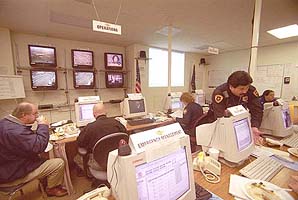 City – they could be thought of as the “top of the
ladder” if one were to draw up an organizational chart. In response to any and
all public safety needs for the event the SLOC created a branch of the SLOC
called the Utah Olympic Public Safety Command (UOPSC), which included the FBI,
CIA, ATF, Secret Service, bomb squads, branches of the military…43 different
federal, state and local agencies in all. On an operational level, the UOPSC
maintained a command post - called the
Olympic Command Post (OCC) in Salt Lake City. This post, in operation 24 hours
a day, kept a constant pulse on anything and everything that was happening
having to do with the Winter Olympics. Other vital city agencies, such as
Public Works, etc., maintained a presence at the OCC as well.
City – they could be thought of as the “top of the
ladder” if one were to draw up an organizational chart. In response to any and
all public safety needs for the event the SLOC created a branch of the SLOC
called the Utah Olympic Public Safety Command (UOPSC), which included the FBI,
CIA, ATF, Secret Service, bomb squads, branches of the military…43 different
federal, state and local agencies in all. On an operational level, the UOPSC
maintained a command post - called the
Olympic Command Post (OCC) in Salt Lake City. This post, in operation 24 hours
a day, kept a constant pulse on anything and everything that was happening
having to do with the Winter Olympics. Other vital city agencies, such as
Public Works, etc., maintained a presence at the OCC as well.
When it came to fire and EMS protection specifically, because nine of the Olympic Competition Venues were not located in the Salt Lake City Fire Protection District, and because other EMS providers would be working at those and Salt Lake City venues in conjunction with the SLCFD, a branch of the UOPSC was created on the planning level that would be responsible for coordinating all fire protection, fire suppression, EMS and medical transport agencies involved with the games called Fire/EMS 2002. Local fire departments, including Salt Lake County FD, Park City FD, West Valley FD, Provo FD, Ogden City FD and Weber County FD, provided fire and EMS protection at various different Olympic events, depending upon the location of the venue. Thus, the Salt Lake City Fire Department became a cog – a fair-sized cog, but a cog nonetheless – in a huge machine.
The SLCFD still had its work cut
out for it, however – there was still the City, 6 Olympic Venues, 6 Olympic
Sponsor tents, 15 designated “protest sites” and numerous other large public 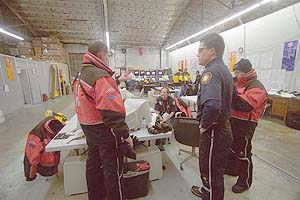 gathering
places to insure the safety of. The first thing they did was to assign
Venue Commanders, who would attend meetings with the SLOC and other interested
parties of each particular venue to determine what specific role the SLCFD
would play there and what the particular needs for that venue might be over the
course of the Olympiad. Tabletop drills were conducted, and over time a better
picture began to emerge of what SLCFD resources would be needed. The Venue
Commanders in turn relayed what they learned to the Fire/EMS 2002 Command, to
be worked into the “bigger picture”.
gathering
places to insure the safety of. The first thing they did was to assign
Venue Commanders, who would attend meetings with the SLOC and other interested
parties of each particular venue to determine what specific role the SLCFD
would play there and what the particular needs for that venue might be over the
course of the Olympiad. Tabletop drills were conducted, and over time a better
picture began to emerge of what SLCFD resources would be needed. The Venue
Commanders in turn relayed what they learned to the Fire/EMS 2002 Command, to
be worked into the “bigger picture”.
The next problem was that of funding and allocating resources for fire protection. Each particular fire or EMS agency was responsible for funding its own efforts (as opposed to sharing a joint budget) so each agency was required to present its own needs to the UOPSC. Working from a $25 million budget, UOPSC allocated 52,000 hours of overtime to the SLCFD, which then had the task of divvying-up the hours.
The SLCFD knew two things: that they had absolutely no idea of how many man-hours it would take to run the operation, but also that they were absolutely sure that they wanted to change as few procedures as possible that were already in-place in the day-to-day operations of the department. After some hashing-out they worked up a plan wherein the staffing and payroll of Olympic overtime shifts was kept completely separate from the normal work schedule and payroll process. In October of 2001, it was announced that all vacation requests for the month of February 2002 would be denied, and in addition a sign-up list was being “posted” for anyone who wished to work overtime at the games, on a completely volunteer basis – not one firefighter was required to work any overtime shifts if he or she didn’t want to. As it happened, 98% of the SLCFD firefighters signed up for the shifts. As a result, a typical shift during the games saw 180 firefighters on duty, as opposed to a normal (non-Olympics) staffing of 79.
The SLCFD got a boost with some
apparatus as well. Through an arrangement with Pierce, eight front-line
pumpers, one quint and one heavy rescue, all painted in a special USA
red-white-and-blue Olympic paint scheme, were donated for use during the
Olympics. The SLCFD in turn designated these units as “sanitized units”,
meaning that prior to being placed into service each rig was inspected by the
Secret Service with a fine-tooth comb and declared “clean”. These units were
then special-assigned to secure areas (such as the Olympic Village where the athletes
lived or within the venues) and would not leave the firehouse for any other
calls except those within secure areas, so as to avoid their being
“contaminated” with the possibility of their being tampered with. Conversely,
no other SLCFD apparatus was allowed within these secure areas – without
exception – without having to stop at a security checkpoint for a “vehicle
sweep”, which could take up to 20 minutes…even if they were responding to a
confirmed fire!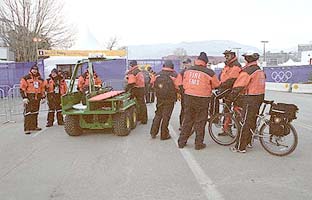
Aside from the Sanitized Rigs, very little else was changed as far as response districts or alarm assignments was concerned, with each company responding to calls in their normally-assigned district. The only additional apparatus used were three John Deere six-wheel “Gators” equipped with light bars and backboards and BLS equipment, which were assigned to the Olympic Square and Olympic Medals Plaza respectively, and ten Bike Teams of two Firefighter/EMT’s each which would also patrol the downtown Olympic Venues. The Gators and Bike Teams enabled the SLCFD to provide a quick response to areas where large crowds would be gathering and render service until rescue and/or ambulance personnel could be brought in…a process that due to the heightened security measures could take some time.
~~~~
It is now 7:30 p.m. on the night of February 8th, and that word “security” is again foremost on everyone’s lips and minds. I am standing on the 7th floor of the Salt Lake City Public Safety Building with a roomful of Chiefs, waiting for the Opening Ceremonies of the 19th Winter Olympiad to begin. To my left is a big-screen TV tuned to NBC; to my right Chiefs Querry, Littleford and Rock alternate between tag-team trips down to the Agency Command Center on the first floor and standing at the window, binoculars in hand, watching the Rice-Eccles Olympic Stadium some four miles away, as police and fire radios chatter in the background. President Bush is in town, and his motorcade has just made a wrong turn on its way to the stadium, and is now in danger of driving right past where a group of protestors have set up. After a few anxious moments the ceremonies begin without a hitch, and as the National Anthem begins we all stand. As I watch the Chiefs’ faces I realize that for them it has all come down to this moment: years of meetings, worrying and planning; of endless tabletop drills, logistics and coordination…the moment of truth begins, and as the fireworks rise above the stadium and the torch arrives to light the Olympic Flame, so does the pizza as we sit down to enjoy the show, the Olympic Rings illuminated in the night on a mountainside far above us.
The following day dawns clear and cold, but I am excited as I learn I’ve been granted access to what is no doubt right now the most secure place on earth: the Olympic Village, home to all the athletes during the Olympics. Located in the foothills of the Wasatch Range just east of the city, the Village is actually the campus of the University of Utah that has been converted to house the teams during their stay.
I have never seen so much security
in place in my life. The process of my gaining entry is manifold: because Chief
Kauffmann’s “unsanitized” vehicle cannot enter without a complete vehicle
sweep, we are met at the first security checkpoint by Battalion Chief (and
Olympic Village Fire Venue Commander) Kurt Cook in his vehicle. After I
transfer all of my gear I am issued a special Olympic Village pass (which is
useless without first having a SLOC-Accredited general credential) and we make
our way through two more Secret Service checkpoints and a cement-barrier
serpentine before we’re actually inside. Chief Cooke points out other security
measures that are not so easily seen: electric fences with built-in motion
sensors; 91 security cameras that cover virtually every square foot of the
Village which are capable of zooming in close enough to read a credential
around someone’s neck; snipers housed in the top floor of a campus hi-rise
available at moment’s notice; GPS units in every shuttle van that will sound an
alarm if the driver stops or goes off course…all I know is that I cannot seem
to look anywhere without seeing at least two police or security personnel. It’s
a comforting – if not somewhat creepy – feeling. 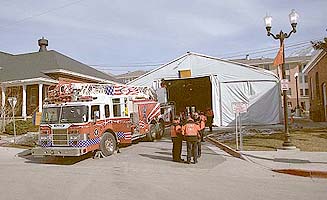
The fire “station” in the Village is actually a large heated tent with a big Velcro “zipper” in the front. Today a drill is scheduled with the truck on aerial operations, and as the crew raises the ladder we become an impromptu media event, with athletes and SLOC volunteers alike stopping to have their pictures taken with the firefighters in front of the rig. We meet Lea Ann Parsley, U.S. Olympic Skeleton Team member who is a volunteer firefighter – and who was 1999 Ohio Firefighter of the Year - in Granville, Ohio, and Peter Kondrat, Czech Republic 4-Man Bobsled Team member who is a career firefighter, and we share the chance to exchange firefighting experiences from a land far from ours. A while later we all retire to the “dorm”: since there are no living accommodations in the tent, the firefighters were invited to take rooms in the same dormitory as the Russian athletes. As the sun goes down, we all gather around the TV, trade gossip and insults and feast on free McDonalds…no different than any other firehouse anywhere in the world…except that today the world is here, with us.
~~~~
It is nighttime in the Salt Lake Olympic Square, and I am riding with “Gator 2”, which is assigned to both the Square and the Olympic Medals Plaza. The crew tonight is Paramedic Mark Morger and Paramedic Tony Allred, and after making our way through the obligatory vehicle-sweep, the “mag-and-bag” (magnetometer and bag-check checkpoint that is at every entrance to every secure venue) and getting our “OMP” credentials, we slowly putt-putt around the venue, looking for action.
Despite the crowds, there isn’t
much happening so at 8:00 p.m. we make our way over to the Medals Plaza to
watch the awards ceremony. In a blaze of colored lights and symphony, we watch
the women of the Freestyle-Moguls Competition take the stage to receive their
medals. Soon after, it is time for music and celebration at the Dave Matthews
Band takes the stage, and it isn’t long before the entire capacity crowd of
20,000 is rockin’ and boppin’ to the beat.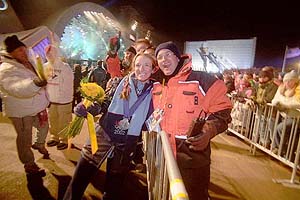
There is a blur just to my left, and as I look it is U.S. Ski Team Member Shannon Bahrke, rushing in to be with her family after just receiving her Silver Medal. She is ecstatic, and as she celebrates and shows off her medal she comes over to join us for a high-five and a group photo. Pretty soon all of us – including the Venue Commander – are dancing and laughing together.
As I danced, I looked around me, at all of the happy faces of those from all around the world, and I had my transcendental moment. It was almost a renewal of faith, and it was comforting in a way that I couldn’t describe. The world may be going through some hard times and some changes, but I knew that together – firefighters, police, organizers, athletes and all the spectators from all over the world – we would work together as one to take on any challenges that might come before us, and to see them through.




