The Confederated Tribes of Warm Springs
(From National Fire & Rescue Magazine, April, 2003)
“How glorious a
greeting the sun gives the mountains!”
So said environmentalist John Muir, and as I stand in the cold morning light, my breath condensing in clouds in front of me, I cannot help but agree. My arrival here at the Confederated Tribes of Warm Springs, Oregon Indian Reservation last night occurred after dark; this early morning walk is my first opportunity to see the land where I will be spending the next few days, riding along with Warm Springs Fire & Safety and learning what it is like to be a firefighter or rescue worker as part of an American Indian Sovereign Nation.
I admit to myself that the idea of visiting and writing about American Indians has made me uneasy. Here, on their land, I am an Outsider, a minority: I am the White Man; I am an embodiment of a selfish, ruthless oppressive force that for me is a shameful part of American history. At the same time, however I realize that in thinking this way I might be guilty of a prejudice too…not a good way for a journalist to begin researching a story! As I walk across the street to an overlook, I resolve to keep as open a mind as I possibly can.
But as I reach the edge of the bluff and look out over the landscape, it is impossible to keep from drawing on clichés about Native Americans and their deep, spiritual relationship with the nature and the land: the view is spectacular. An open high-desert valley is spread out in front of me, surrounded by towering buttes that glow shades of tan, orange and deep red as the morning sun hits them. In the distance, table-top mesas reach to the horizon, where a snow-capped Mount Jefferson rises into the sky. The aromas of Sagebrush and Juniper fill the air, along with the smells of late-fall desert - clean, crisp and dry early-morning smells that invigorate and refresh the soul. The experience sets my mood: outsider that I am, I will do my best to see things – and thus tell – how it is through their eyes.
~~~~
The Confederated Tribes of the Warm Springs Reservation, not unlike other American Indian reservations throughout the United States, had its beginnings in the 1800’s, as settlers made their way west and began to take over lands that had been home to local Indian tribes for thousands of years. Among the tribes that lived in the Columbia Plateau section of Central Oregon were the Wasco Tribe, a Chinooktan linguistic group of people, which occupied the area of the lower Columbia River, and the Warm Springs tribe, a Sahaptin-speaking people, which had their roots in an area farther up the Columbia River and on the Deschutes and John Day Rivers.
By 1852, almost 12,000 immigrants were crossing the land of the Wasco and Warm Springs tribes each year. In 1855 the Superintendent for the Oregon Territory, Joel Palmer, received orders to clear the Indians from their lands. He did this by negotiating a series of treaties with the Indians, including a treaty that established the Warm Springs Indian Reservation. Under this treaty, the Warm Springs and Wasco tribes relinquished approximately ten million acres of land, but reserved the Warm Springs Reservation – over 600,000 acres - for their exclusive use. The tribes also kept the right to harvest fish, game and other foods off of the reservation in their usual and accustomed places.
In 1879, the United States moved a group of 38 Paiute Indians from the Yakama Reservation to the southern part of the Warm Springs Reservation. These 38 Paiutes, part of a nomadic tribe that had traditionally roamed a vast territory that included parts of the Deschutes and John Day River valleys and high desert lands to the east and south, had been forced to move to the Yakama Reservation and Fort Vancouver after joining the Bannocks in a war against the U.S. Army. In 1884 another group of Paiutes was moved to Warm Springs. After being relocated, the Paiutes received allotments of reservation land and became residents of the reservation. Eventually the two treaty tribes, the Wasco and Warm Springs tribes, invited the Paiutes to join their government.
In 1937, after Congress passed the Indian Reorganization Act of 1934 (the Wheeler-Howard Act) which was designed to revitalize Indian communities and bolster Indian tribes as governments, the Warm Springs, Wasco and Northern Paiute Tribes officially formed a confederacy, established a common government and adopted a written constitution. This constitution created a Tribal Council for administrative purposes, and reserved all other sovereign powers to the people. In 1992 the three tribes thus became the Confederated Tribes of the Warm Springs Reservation, a sovereign nation unto its own.
~~~~
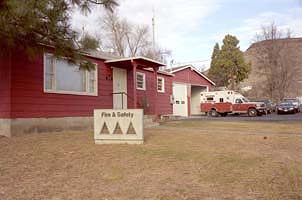
I make my way back to “Agency Station” – the small residence with detached garages that serves as the Warm Springs Fire & Safety Headquarters - where I am met by Firefighter/EMT RaNeva Dowty, A member of the Warm Springs tribe who will be my guide for the day. Together we hop into a FD utility vehicle for a tour of the district.
Warm Springs Fire & Safety has four stations: the Agency (Headquarters) Station, which houses one Class-A mini-pumper, one rescue truck, two ALS-equipped ambulances and one ILS-equipped ambulance; the Agency Annex – essentially a storage facility – which houses two water-tenders and one brush rig; Simnasho Station, which houses one pumper-tender and one ALS-equipped ambulance, and the new Kah-Nee-Tah Station, which houses one Class-A pumper. The latter was built to protect the Kah-Nee-Tah Village, a campground of sorts, and the Kah-Nee-Tah Lodge, a luxury hotel, resort areas on the reservation. A gaming addition to the Lodge, the Indian Head Casino, was opened in 1996.
Our first stop will be Simnasho
Station. As we make our way to the top of a mesa and into a forest of Douglas
Fir, RaNeva points out various highlights in the landscape, and tries to give
me a sense of the natural features that make up the Warm Springs Reservation.
Over half of the reservation is forested, with the remainder primarily range
land. Bounded on the west by Mt. Jefferson and the Oregon Cascade mountain
range, the reservation extends east through a drop of over 9,000 ft in
elevation to the Deschutes River, where it meets the southern boundary of Lake
Billy Chinook and the Metolius River.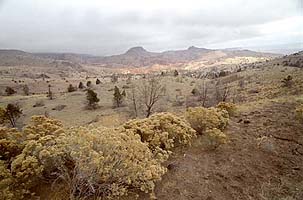
The Reservation is huge. Where I’m from, a fire department’s response district might be just a couple of square miles; RaNeva explains to me – with a smile - that their response area is over 921 square miles. My surprise is even greater when she tells me that on any given day there are usually no more than five full-time members on duty: two or three at Agency Station and two at Simnasho Station…and it didn’t always used to be that way.
Warm Springs Fire & Safety had its beginnings in 1979, when the elderly Tribal Safety Officer of the time, Elmer Quinn, became ill and it became clear that he could no longer effectively perform his duties. Up until that time, the Bureau of Indian Affairs (BIA) handled all of the firefighting duties on the reservation, while any EMS calls were handled by the Police Department. Neither agency was really properly equipped or trained to handle the task properly, so in 1979 the Tribal Council appointed their first Fire Chief, Ray Rivera, and began to lay out plans for their first on-site Fire Department. Shortly thereafter, in April of 1980, Jerry Huff was hired as a Captain/Training Officer, and two months later in June the first five Firefighter/EMTs were hired, including current Fire Chief Dan Martinez. Aside from Martinez, who had spent some time as a volunteer, none of the recruits had any experience whatsoever – they were literally starting from scratch and learning as they went. Although they began responding to fires and medical calls right away, it would be two years before the first EMTs were certified.
Construction of the Simnasho and Kah-Nee-Tah stations also began around that time. It wasn’t until 1983, however, that Simnasho station became manned, and then it was only with one person. Agency Station was manned by only one full-time Firefighter/EMT at that time as well; any additional help at the scene was made up of volunteers and Police Officers, who would follow tradition by acting as drivers for the ambulances. It would be close to 18 years until a second full-time Firefighter/EMT was added there, and then it was only by sheer necessity. As the population of the reservation grew so did the calls for fire and rescue, and equipment and personnel were added as funds permitted. “We’ve doubled our staff,” Jerry Huff explained to me later, “but we’ve only done that in the last couple of years. The call volume got so intense that we just couldn’t handle it.” Today Warm Springs’ call volume is over 2,200 calls annually; that combined with a current personnel roster of 27 paid and 18 volunteer members makes for a pretty busy little fire department.
I remember hearing that the population of the Warm Springs Indian Reservation is somewhere around 4,100. Hmmm…2,200 calls annually, with such a small population…I begin to think that there might be a darker side to all of this; some sad truths that need to be explored.
~~~~
I’ve discovered one of them: as beautiful as it is, this
highway we’re on can be a killer! RaNeva and I have just left Simnasho Station,
and after some coffee and donuts with Ron Morgan and Brian Huff, the on-duty
crew there for today, we’re heading up Oregon State Highway 26 as we continue
our tour of the reservation. Route 26 runs right through the reservation, and
is also the main road that connects Portland with Bend and other points of
interest in central Oregon. 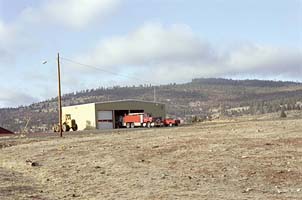 There is always traffic on this road, especially
during the weekends and during the summer tourist season, and as we travel
under a big, wide-open sky down a seemingly-endless straight stretch of road I
can picture folks getting a bit impatient with doing 55 mph. Oddly enough, however,
it is these clear, straight, unobstructed sections of road where many of the
accidents occur (RaNeva tells me with a smile that in the local vernacular
motorists “fail to negotiate the straightaway”- !)
There is always traffic on this road, especially
during the weekends and during the summer tourist season, and as we travel
under a big, wide-open sky down a seemingly-endless straight stretch of road I
can picture folks getting a bit impatient with doing 55 mph. Oddly enough, however,
it is these clear, straight, unobstructed sections of road where many of the
accidents occur (RaNeva tells me with a smile that in the local vernacular
motorists “fail to negotiate the straightaway”- !)
As dangerous as the highway might be, MVAs only make up roughly 5% of the calls Warm Springs handles annually. Like many departments, the largest percentage of calls – close to 90% - are medical calls, and in Warm Springs a surprising number of those – at least 400, over 20% - are at the local jail.
I experience this firsthand later that evening, when back at Agency Station we’re called there for an adult male who is highly intoxicated. While many police agencies won’t bother to call out EMS for an intoxicated subject, it’s a common occurrence in Warm Springs, where BAC levels can sometimes reach frighteningly high levels. EMT’s Joe Tornbon and Dusty Miller, along with volunteer firefighter John Miller, check out the subject and declare him to be in no medical danger. With no need to transport, we head back to Agency Station.
But my fears have again been raised. I am once again forced to compare my prejudices – what I think I know about American Indian culture – to what the actual truth is. The “A”-word – Alcoholism – comes to mind, and it makes me uneasy. Are the myths true? How do I even ask about it without appearing insensitive or bigoted?
I decide to approach the whole issue of prejudice with nothing but straightforward honesty about my fears, and the following afternoon I get my chance to ask all these questions and more as I sit down to lunch with Warm Springs Fire Chief Dan Martinez and Don Courtney, Warm Springs Police Chief and Acting Public Safety Manager. What I find out is that the Confederated Tribes of Warm Springs are caught in a battle of past and present, and that being a small Sovereign Nation can be a double-edged sword.
What it all comes down to is culture. The American Indians of Warm Springs – like the other 217 recognized tribes across the United States – are desperately trying to maintain and continue traditions that have been unique to their Indian heritage for many thousands of years, but they find themselves fighting a losing war against the modern world of the 21st century. It is not so much that they have a problem with the modern world per se; the problem lies with how the “old” and “new” worlds interact: ancient traditions don’t always jive with modern practices, and the same borders that protect and maintain the Warm Springs Indian culture can sometimes keep out changes that may be healthy and necessary for their society to grow. The result is an attempt to “ride the fence” between the two worlds…which is not always successful.
A case in
point – and one that has far-reaching consequences within the public safety
sector of the Warm Springs Reservation – has to do with the hiring of
non-Native Americans as firefighters and EMTs. I was quite surprised when I
first arrived to see that the majority of firefighters were not Native
American, but were in fact Anglo. This fact seemed very puzzling in light of
the fact that I was on a self-contained, self-governing Indian reservation.
Chief Martinez explained to me however that as a result of their sovereignty,
this could easily be the case. 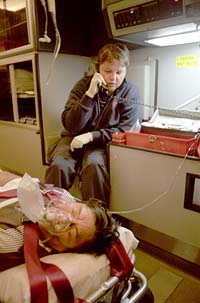 “The problem we face is the fact that being the
close-networked family that we are within the reservation, the minute they
respond and they start dealing with nieces, cousins, brothers, sisters, aunts,
grandfathers, etc. they become overwhelmed by it.” Having to see and deal with
relatives and friends in pain and need on a regular basis takes a heavy toll on
the spirit of emergency workers who live in the same community where they work.
“The average time to burnout is about three to five years, where some of the
locals would burn out because they got tired of having to take care of their
family members. We average about 2100 calls annually: high suicide rate, high
alcohol ratio, numerous accidents, structure fires, wildland-urban
interface…all that plays a role in recruiting tribal members here.”
“The problem we face is the fact that being the
close-networked family that we are within the reservation, the minute they
respond and they start dealing with nieces, cousins, brothers, sisters, aunts,
grandfathers, etc. they become overwhelmed by it.” Having to see and deal with
relatives and friends in pain and need on a regular basis takes a heavy toll on
the spirit of emergency workers who live in the same community where they work.
“The average time to burnout is about three to five years, where some of the
locals would burn out because they got tired of having to take care of their
family members. We average about 2100 calls annually: high suicide rate, high
alcohol ratio, numerous accidents, structure fires, wildland-urban
interface…all that plays a role in recruiting tribal members here.”
One could argue that sure, that’s not unique; many small departments across the country as well could and do suffer from the same “small-town” syndrome. But there is an element of Native American culture that comes into play here, in the form of a tradition of stoicism. “A lot of times Native Americans are not going to come out and say, ‘this is bothering me’. They’re simply not going to do it because they’re taught culturally not to do that.” And, rather than saying anything, they just simply quit. In an example of an application of “modern” techniques, Chief Martinez is working hard to get his members to speak more openly about their feelings, and has even implemented a mandatory Critical Incident Stress Debriefing program in the event an employee witnesses a death, or has a family member or friend die on one of their calls. The program may be working: eight new Native American members have been recruited in the last year alone, where in previous years the annual average has been two, with one member dropping out for every new member that was hired.
Owing to the difficulty in hiring Native Americans, the need for personnel required that the Tribal Council open the hiring eligibility to non-natives. This solution, however, brought some problems of its own. Distrust, it seems, goes both ways.
“The challenge is that local people want local people helping them,” Chief Martinez explained. “They become very resentful when they see a non-Indian in the community. First of all, you’re a stranger. Second, you’re taking care of [the worst kind of] crisis situations – 911 calls. It’s almost as if you have to prove yourself before these people accept you…and proving yourself takes time. It’s not good enough that I hired them; at any given moment these people can, in fact, turn on you. You’re the minority here; you’re the White Man amongst 4100 tribal members.” The differences in being a sovereign nation become obvious here too, since Public Safety is not paid through taxes and every member of the reservation is a “stockholder”, so to speak, whose opinion on how things are run matters as much as any other member’s. “Their expectation is that because they see you’re a stranger, they’ll really pick on you on issues [of your performance at the scene] even though you’ve done your best. It’s just unfortunate that we’ve become prejudiced against non-tribal members. It’s not the right thing, but that’s just the way the people are.”
The high expectations of the Native American public of Warm Springs are not limited to non-natives, however; if anything the Native American members of the Fire & Safety crew are under as much, if not more, scrutiny and pressure to perform well.
“In the Indian world, you’re responsible, you’re accountable, and there’s the expectation and demand that you do your very best, 24 hours a day, 7 days a week, and you always give it your best. It’s unforgiven if you make any mistake.”
“That’s a cultural thing?” I asked.
“Oh yeah…even if you’re right. We had one situation where we were doing CPR on an Elder, and we were doing everything right, including baring the chest. The family was extremely upset with us; they thought it was disrespectful to an Elder. In a traditional perspective it was; it was the equivalent of holding a funeral with a naked body. They quizzed me on it – why didn’t I stop it? I had to sit there with the family and explain ‘well, this is how we perform CPR, this his how we monitor the chest…’ I had to apologize to the family…they’re still mad today, and it’s been almost a year now.”
To make matters worse, no one forgets these “transgressions”, and they can have a huge impact on the future administration of the fire department, such as requests for funding. “That kind of incident could very well result in having our budget cut in half, or have a tribal member petition you – and they’ve done this – to say ‘do not fund the Fire Department because they bared the chest of my Elder.’”
The expectations of the tribal members go even beyond that: in their eyes, the duties of the fire department include anything to do with fire safety, from clearing brush away from a structure all the way down to coming over to their houses to replace batteries every time their smoke detectors go dead. The attitude is, “If you say this is a problem, why don’t you fix it?” Just why public safety agencies such as the fire department have such demands placed on them by tribal members remains a mystery to Chief Martinez.
~~~~
The next day, Sunday, starts off like Sundays should: a
lazy, quiet morning with breakfast at the Deschutes Crossing restaurant,
followed by some down time at the firehouse, with RaNeva doing some studying
and Firefighter/EMT Jason Scholl sneaking in a morning nap. Harry Potter’s on
the TV, and just as he’s arriving at Hogwarts a call comes in for a three-year-old
child in seizures and boom we’re out the door in a flash.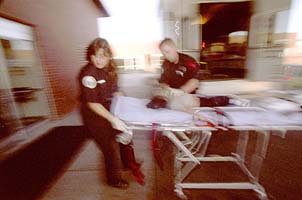
I’m not even fully aware of the seriousness of the call until we arrive at the residence, when before I can even step inside the door RaNeva rushes by me with the child in her arms, calling for a hospital Trauma Team activation. Warm Springs Police Officer Renee Holliday takes the wheel of the rig, and we head off towards Mountain View Hospital in Madras, a full 15 miles away.
Our quick work pays off, and the little girl will be OK. As RaNeva fills out paperwork, Jason and I watch as the girl’s family members gather around her on the ER gurney, hold hands, and begin to softly sing a prayer in their native language. I am touched by what I see; it is my first experience witnessing a scene where two worlds – the ancient and traditional and the new and technological – have come together in an uneasy truce.
I am told of other situations where this happens. In the Warm Springs Early Childhood Educational Center, for example, blankets are still kept covered over stored baby backboards so as to keep away evil spirits. This presented a potential problem for the fire department, since there was concern that the blankets might conceal possible victims during a search if they were to have a fire there.
Another problem has to due with tribal cultures regarding death. “There are some Indian tribes that refuse to go inside a house where there is a death that involves tribal members,” Chief Martinez explains. This can even present problems for firefighting, let alone EMS responses. “Even though they’re taught to put the fire out, they would just as soon not even go near the fire, knowing there may be a deceased person in there.”
This problem can extend to incident reporting as well. According to some tribal customs, when a person dies it is forbidden to mention that person’s name for an entire year after their death. “We believe in not saying an individual’s name for one year, which raises some issues in the event we have to testify in court” says Martinez, “In the event [the death] needs to be investigated it’s really hard for the tribal membership not to say that name for an entire year, even though it’s almost mandated to do so…it’s an awkward thing.”
Other statistics support the fact that the Native American culture is having a hard time adapting to the modern world in terms of fire safety and prevention. In the minutes from the Second Meeting on the Native American Fire Prevention Initiative held in May of 2002, numerous problems in the Native American community were recognized, including the following:
· 50% of Native American housing stock is virtually uninsured
· Although Native Americans make up roughly 2% of the U.S. population, their death rate is 3.5 times the national average
· There is a lack of interest and/or awareness in fire safety in the Native American Community, perhaps due to a cultural mindset of “if you plan for something bad to happen, it will happen”
· Culturally-sensitive fire prevention programs and materials are inadequate
· Fire Department resources (personnel, equipment, funding) are inadequate
· Jurisdictional problems exist. Because the tribes are sovereign people, involving local and state resources will be difficult in many cases.
Another large problem that exists is one of cultural sensitivity, especially having to do with educating non-Native Americans about the cultural needs and mores of local Native American communities. A case in point occurred in 1996, when several large wildfires came together in the Simnasho section of the Warm Springs Reservation.
A U.S. Forest Service Task Force crew set up camp inside a tribal Long House without consulting any members of the Tribal Council, and went on to cross cultural boundaries by smoking in the building, playing loud rock music, swearing and leaving the showers a mess. While this behavior might be condoned in some firehouses, it was an affront to the Warm Springs people, and the firefighters were thrown out immediately. At the same fire, a different crew that had been without showers for several days decided to clean up by wading in the Warm Springs River. No one had told them that the river was sacred and could not be used without permission; they too were sent home.
The good news is that these problems have been recognized, and that many agencies are working hard to correct them. Organizations like the National Native American Fire Chiefs Association, working in conjunction with FEMA and the BIA, have instigated programs such as the Native American-Alaska Native Fire Prevention Outreach Program that are specifically designed to try to address the specific problems and needs of promoting fire safety education and equipment in Native American communities. Warm Springs Fire & Safety is no different in that they deal with the same problems as every other Native American sovereign nation does across the United States; their one advantage is that Chief Martinez, as an active member of both the NNAFCA and the National Native American Emergency Medical Services Association, will most likely keep Warm Springs at the front of the line of communities that will benefit from these programs.
~~~~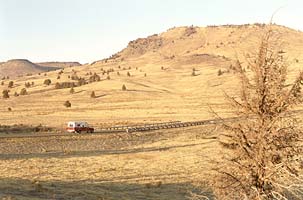
Monday morning dawns bright and chilly, and frost gleams from the shady side of rocks and trees as Firefighter/EMT Anne Trueax, Firefighter/Paramedic Karla Bagley-Tias and I make our way in the ambulance across a wide valley of grassland and scrub to a new residential area outside of town. Through the back window of the rig I see a hawk soar across the sky. It reminds me again of a passage I read from the Warm Springs Declaration of Sovereignty:
“Our sovereignty is based not on the laws of human beings, but on natural laws given to us by our Creator; these natural laws are as they are, not as human beings may define them.”
From the control panel in back, Karla radios dispatch, and readies her handheld Pulse Oximeter. We should be arriving soon.




